


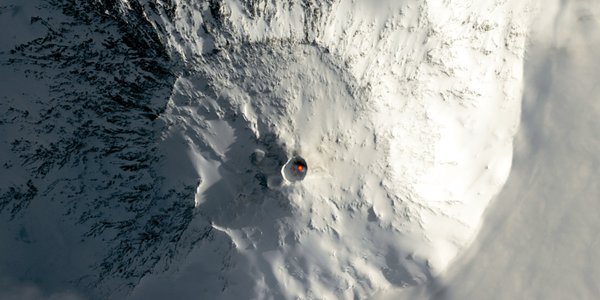
Antarctic Volcano Spews Gold Dust, Not Lava
Translated from Polish, summarized and contextualized by DistantNews.
At a glance
News
Sources not specified
Context piece
- Mount Erebus, Antarctica's second-highest and most active volcano, is the southernmost active volcano on Earth.
- Scientists discovered microscopic particles of crystalline elemental gold in gases emitted from the volcano, with daily emissions estimated at 80 grams.
- While gold has been detected in other volcanoes, Erebus is unique for its consistent expulsion of pure gold particles, a phenomenon still being studied.
Mount Erebus, a towering volcano on Antarctica's Ross Island, presents a unique geological marvel: it spews not lava, but microscopic particles of pure gold. This active volcano, the southernmost on Earth, is a source of fascination for scientists studying its unusual emissions.
The volcano ejects about 80 grams of microscopic gold dust daily, spreading it up to 1,000 kilometers away, and even further.
Research published in "Geophysical Research Letters" indicates that Erebus releases approximately 80 grams of this golden dust daily, with particles dispersing up to 1,000 kilometers. Although the discovery dates back to 1991, Erebus remains the only known volcano globally to eject crystalline elemental gold.
The exact mechanism by which gold separates from magma and becomes airborne remains a puzzle. While trace amounts of gold have been chemically identified in other volcanic samples, Erebus's consistent output of pure gold particles sets it apart. Scientists theorize that gold may be transported via hot volcanic fluids and gases, potentially bonding with volatile compounds like chlorine or sulfur.
This is still the only known volcano in the world that ejects particles of crystalline elemental gold.
Geochemist Kimberly Meeker's team has collected samples from the volcano's vicinity, including gas from its lava lake and the Antarctic troposphere. Microscopic analysis revealed near-perfect geometric crystals of gold, some measuring around 60 micrometers. This contrasts with the much larger daily gold output estimated for Mount Etna, highlighting the distinct processes at play within Erebus.
gold from Mount Erebus behaves in a way that is not seen in any other volcano.
DistantNews Editorial
Originally published by Rzeczpospolita in Polish. Translated, summarized, and contextualized by our editorial team with added local perspective. Read our editorial standards.
More Stories

From Our Blog

What Gets Lost (and Found) When News Is Translated

The Critical Role of Diaspora Media in Global News

What Travellers Should Know About Countries with Restricted Press

A Digital Nomad's Guide to Following Local News

How the Same Story Looks Different in Different Countries
