


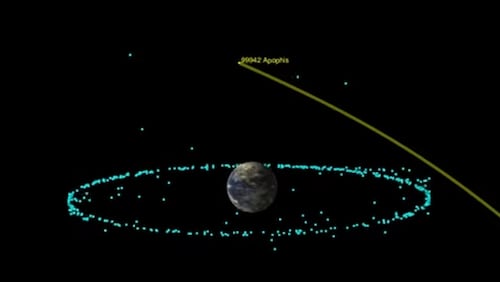
Apophis asteroid, size of Eiffel Tower, to make historic close Earth pass
Translated from Spanish, summarized and contextualized by DistantNews.
At a glance
News
Official statement
Context piece
- Asteroid 99942 Apophis will pass Earth on April 13, 2029, at a distance of about 32,000 kilometers.
- This close approach by a 340-meter wide asteroid is unprecedented in recorded human history, but NASA assures there is no impact risk.
- The event offers a unique scientific opportunity to study the asteroid's composition and internal structure as it is affected by Earth's gravity.
Asteroid 99942 Apophis, a relic of the early solar system, is set for a historic flyby of Earth on April 13, 2029. It will pass at a distance of approximately 32,000 kilometers, an unprecedented proximity for a celestial body of its size in recorded human history. With a diameter of 340 meters and a longitudinal axis of 450 meters, Apophis is comparable in size to the Eiffel Tower.
Despite its initial nickname, "the god of chaos," NASA has categorically dismissed any danger, stating there is no risk of impact for at least the next 100 years. Experts view the close pass as an exceptional scientific opportunity. Patrick Michel of France's National Centre for Scientific Research stated, "For the first time, nature is bringing us an asteroid and doing the experiment for us."
For the first time, nature is bringing us an asteroid and doing the experiment for us.
Apophis, originating from the main belt between Mars and Jupiter 4.6 billion years ago, is a type S asteroid, primarily composed of silicates and metals. Scientists are particularly interested in its internal structure. Earth's gravity will exert significant forces during the flyby, potentially altering its rotation or causing surface landslides, offering insights into the internal composition of such bodies.
The global scientific community is mobilizing to capitalize on this observation window. NASA's OSIRIS-APEX mission has been redirected to rendezvous with Apophis shortly after its closest approach. The European Space Agency is developing the Ramses mission to monitor real-time changes in the asteroid's orbit and structure. Richard Moissl of the ESA's Planetary Defence Office noted, "This mission will demonstrate that humanity can deploy a reconnaissance mission in a few years to meet an asteroid in close proximity."
This mission will demonstrate that humanity can deploy a reconnaissance mission in a few years to meet an asteroid in close proximity.
DistantNews Editorial
Originally published by El Universal in Spanish. Translated, summarized, and contextualized by our editorial team with added local perspective. Read our editorial standards.
More Stories



From Our Blog

What Press Freedom Means for the News You Read

What Gets Lost (and Found) When News Is Translated

The Critical Role of Diaspora Media in Global News

What Travellers Should Know About Countries with Restricted Press

A Digital Nomad's Guide to Following Local News
