


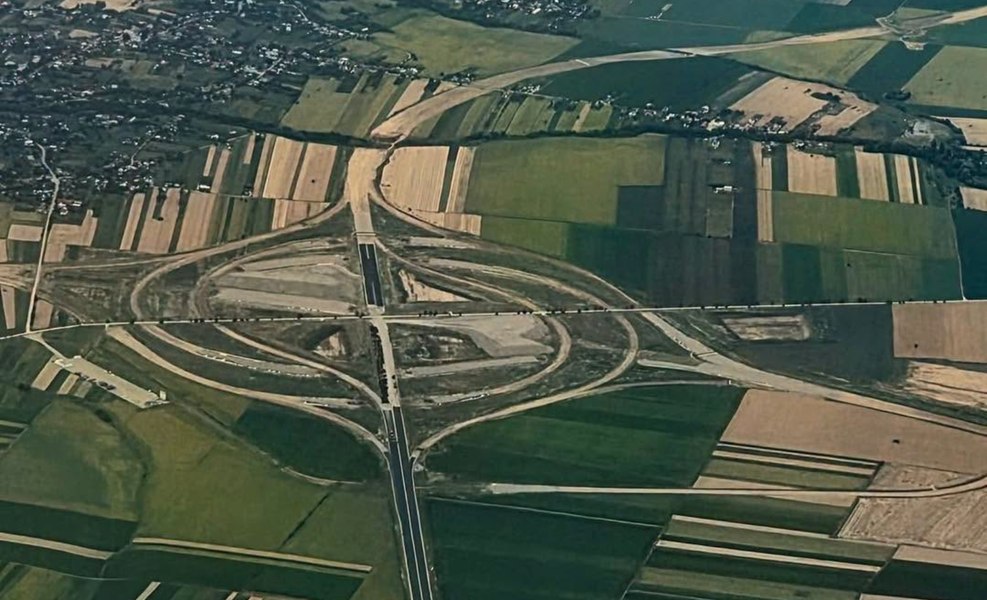
Asphalt Laid on Romania's Largest Highway Interchange Connecting A7 and A8
Translated from Romanian, summarized and contextualized by DistantNews.
At a glance
News
Named sources
Ongoing story
- Asphalt paving has begun on Romania's largest "turbion" (whirlwind) road interchange, connecting the A7 and A8 highways.
- The interchange, located south of Pașcani on Lot 3 of the A7 highway, spans approximately two kilometers and covers 220 hectares.
- This project is part of a significant mobilization of resources on the A7 highway, aiming for the successive opening of all remaining lots by year-end.
The construction of Romania's largest "turbion" (whirlwind) road interchange has commenced, with asphalt paving starting on Lot 3 of the A7 highway connecting Mircești and Pașcani. State Secretary in the Ministry of Transport, Irinel Ionel Scrioșteanu, announced the milestone on Monday, July 13.
This major interchange, situated south of Pașcani in Iași County, will serve as the crucial link between the A7 (Moldova Highway) and the A8 (Union Highway). The project covers an extensive area of 220 hectares and extends for approximately two kilometers. It is designed with eight lanes for an 80 km/h speed limit, 12 underpasses (eight for A7 and four for A8), and five culverts.
On the construction site of Lot 3 Mircești - Pașcani of the Bacău - Pașcani A7 Highway, the contractor has started laying asphalt on the largest whirlwind interchange we are building in Romania.
Scrioșteanu highlighted the immense mobilization of resources across all lots between Bacău and Pașcani on the A7 highway, involving around 4,700 personnel and 1,000 machines. This intensive effort aims to meet the target of opening all remaining A7 sections, including the stretch to Pașcani, by the end of the year. The interchange is expected to enhance connectivity across several European corridors, facilitating links between Southern Europe, Cernăuți, the Republic of Moldova, Transylvania, and Western Europe.
In Moldova, on the Moldova Highway A7, from Adjud to Pașcani, there is the largest mobilization of resources we have ever had at the level of building a high-speed road, with approximately 4,700 people and 1,000 machines present.
DistantNews Editorial
Originally published by Adevărul in Romanian. Translated, summarized, and contextualized by our editorial team with added local perspective. Read our editorial standards.
More Stories


From Our Blog

What Gets Lost (and Found) When News Is Translated

The Critical Role of Diaspora Media in Global News

What Travellers Should Know About Countries with Restricted Press

A Digital Nomad's Guide to Following Local News

How the Same Story Looks Different in Different Countries
