


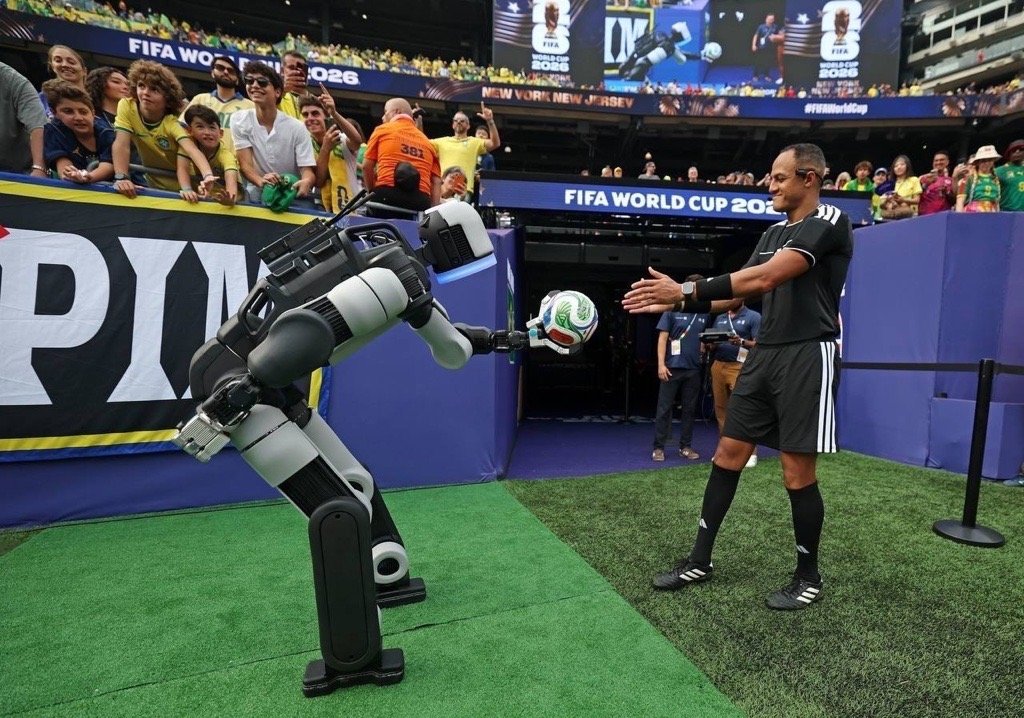
Atlas robot's World Cup halftime show draws international attention
Translated from Korean, summarized and contextualized by DistantNews.
At a glance
News
Named sources
Outcome reported
- Boston Dynamics' Atlas robot performed a halftime show at the 2026 World Cup match between Brazil and Norway, drawing international media attention.
- The humanoid robot showcased goal celebrations and delivered the match ball to the referee, demonstrating advanced adaptability and learning capabilities.
- Foreign media outlets, including Fortune and Bloomberg, highlighted Atlas's ability to adapt to real-world conditions and learn complex movements, distinguishing it from industrial robots.
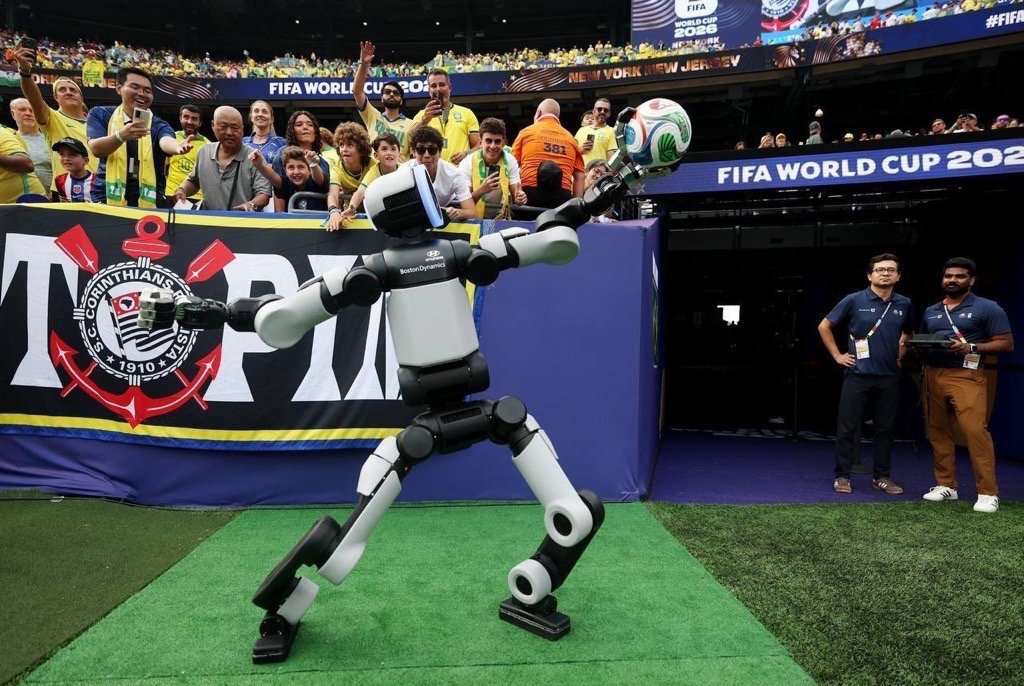
Boston Dynamics' Atlas humanoid robot captivated audiences during a halftime performance at the 2026 World Cup's round of 16 match between Brazil and Norway. Held at the MetLife Stadium in New Jersey, the event saw Atlas execute a series of impressive maneuvers, including mimicking famous soccer players' goal celebrations and handing the match ball to the referee.
Something that has never happened in World Cup history occurred.
International media outlets closely followed the demonstration, with Fortune magazine noting the unprecedented nature of the event in World Cup history. The publication highlighted Atlas's capacity for self-adaptation and learning, differentiating it from pre-programmed industrial robots. Atlas's goal celebration routine was reportedly learned through analyzing videos of famous soccer players and motion capture data.
Unlike robots programmed to move, it has the technology to adapt and learn on its own.
Bloomberg further elaborated on the significance of Atlas's performance, emphasizing the challenges of operating in a dynamic environment like a football field. Unlike controlled laboratory settings, a stadium presents numerous unpredictable variables. Bloomberg reported that Atlas is being trained to adapt to these real-world conditions, showcasing its advanced learning capabilities.
The stadium's grass field is an environment where various variables that do not exist on a laboratory floor can exist.
Reuters also focused on Atlas's successful operation on the grass field, quoting a Boston Dynamics representative who stated that the robot achieved stable movement through a novel learning method. This demonstration underscores Boston Dynamics' advancements in creating robots that can navigate and interact with complex, unpredictable environments.
Atlas is being trained to adapt to variables that occur in real environments.
DistantNews Editorial
Originally published by Dong-A Ilbo in Korean. Translated, summarized, and contextualized by our editorial team with added local perspective. Read our editorial standards.
More Stories


From Our Blog

What Gets Lost (and Found) When News Is Translated

The Critical Role of Diaspora Media in Global News

What Travellers Should Know About Countries with Restricted Press

A Digital Nomad's Guide to Following Local News

How the Same Story Looks Different in Different Countries
