


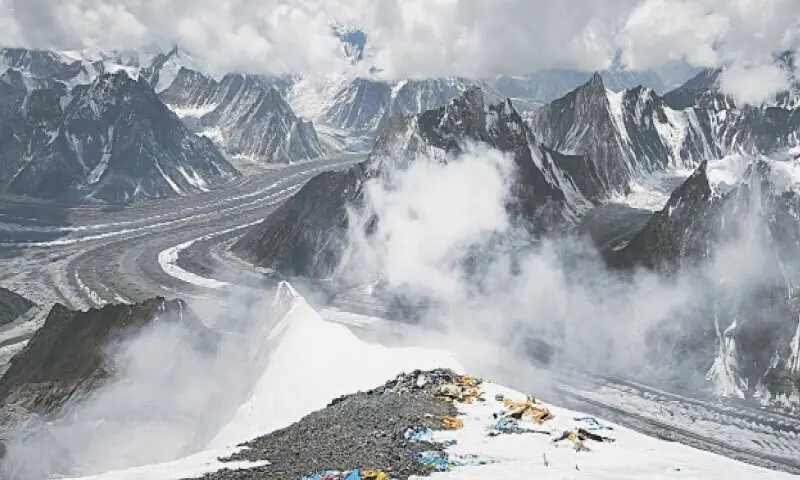
Avalanche risk, bad weather disrupt climbing season in Gilgit-Baltistan
Summarized and contextualized by DistantNews.
At a glance
News
Named sources
Context piece
- Climate change has worsened climbing conditions in Pakistan's Karakoram Range.
- No climbers summited K2 or Gasherbrum-I this summer due to storms, heavy snowfall, and high avalanche risk.
- Shifting weather patterns make planning summit attempts difficult, increasing risks.
Climate change is creating dangerous conditions for mountaineers in Pakistan's Karakoram Range, with shifting weather patterns significantly disrupting the climbing season. This summer, no climbers managed to reach the summits of K2, the world's second-highest mountain, or Gasherbrum-I. Persistent storms, heavy snowfall, and unstable snowpack led to an exceptionally high avalanche risk, hindering attempts on five of the 14 eight-thousander peaks.
Around 40 foreign climbers also failed to summit Gasherbrum-II, Broad Peak, and Nanga Parbat. Expedition teams typically spend weeks at base camps assessing weather and fixing ropes before attempting a summit. However, for the past two years, climbers have faced unpredictable conditions, including avalanches, rockfalls, and strong winds throughout the summer season.
This year, continued bad weather kept teams at base camp, while repeated summit attempts were called off due to unsafe conditions on the mountains.
Ghulam Muhammad, a tour operator, reported that over 200 climbers attempted to summit K2, Broad Peak, Gasherbrum-II, and Gasherbrum-I this year. "This year, continued bad weather kept teams at base camp, while repeated summit attempts were called off due to unsafe conditions on the mountains," he said. While a few foreign expedition groups reached the summit of Gasherbrum-II and one local team summited Broad Peak, the overall success rate was low.
Ayaz Shigri, general secretary of the Alpine Club of Pakistan, noted the unstable weather conditions. He also mentioned that following a devastating avalanche on Broad Peak on July 30 that killed 10 foreign climbers and one Pakistani climber, many at K2 and Gasherbrum-I abandoned their missions to join search and rescue efforts. Asghar Porik, another tour operator, highlighted how changing weather patterns have made traditional climbing schedules unreliable, increasing the risk of avalanches and rockfalls due to rising temperatures.
For 100 or 500 years, climbers have planned their attempts in the Karakoram according to established weather patterns. They usually attempt K2 between July 20 and August 15, with the weather generally considered suitable until the end of June.
DistantNews Editorial
Originally published by Dawn. Summarized and contextualized by our editorial team with added local perspective. Read our editorial standards.
More Stories
From Our Blog

What Gets Lost (and Found) When News Is Translated

The Critical Role of Diaspora Media in Global News

What Travellers Should Know About Countries with Restricted Press

A Digital Nomad's Guide to Following Local News

How the Same Story Looks Different in Different Countries
