


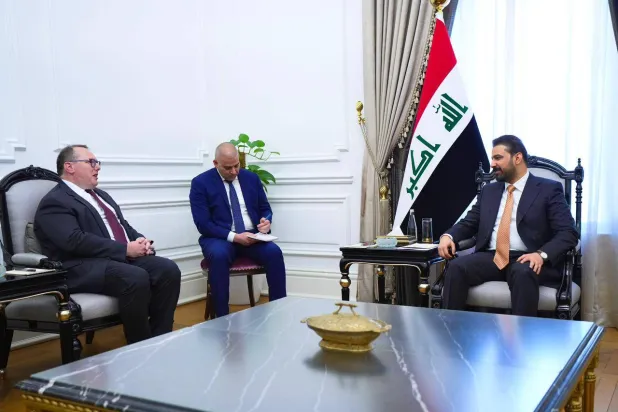
Barrack's Iraq Envoy Role May Intensify US Pressure for Factional Disarmament
Translated from English, summarized and contextualized by DistantNews.
At a glance
News
Named sources
Ongoing story
- Tom Barrack's appointment as US presidential envoy to Iraq may increase pressure on Baghdad to disarm Iran-allied factions.
- Iraqi Prime Minister Ali al-Zaidi is determined to end armed presence outside state control, starting with cleric Moqtada al-Sadr's forces.
- Some factions, like Kataib Hezbollah, refuse to disarm, while others express vague possibilities, creating a complex political landscape.
The recent appointment of Tom Barrack as the US presidential envoy to Iraq is poised to intensify American pressure on Baghdad to disarm factions aligned with Iran. This move aims to curb Tehran's influence within Iraq, a long-standing objective for the US.
Iraqi Prime Minister Ali al-Zaidi has consistently voiced his determination to eliminate all armed groups operating outside state authority. He announced on Saturday that the disarmament process would proceed in phases, beginning with the Saraya al-Salam armed wing, which is part of the state institutions under the direct command of the armed forces. This initial compliance from Moqtada al-Sadr's faction has been described as "encouraging."
The Framework is really interested in reaching a solution to this problem. It wants the process to be simple and away from sharp clashes with the government and factions.
However, the path to full disarmament remains complex. While Sadr has distanced himself from Iran for years, it is uncertain whether Tehran-aligned parties will follow suit. Groups such as Asaib Ahl al-Haq, the Badr Organization, Kataib Sayyid al-Shuhada, Kataib al-Imam Ali, and the Thar-Allah movement have spoken of potential disarmament but have offered vague details on implementation. In stark contrast, Kataib Hezbollah and the Nujaba movement have explicitly refused to relinquish their weapons.
A prominent member of the pro-Iran Coordination Framework, speaking anonymously, suggested that Barrack's appointment will heighten pressure on Prime Minister Zaidi and his coalition to address the issue of weapons held outside state control. The Framework reportedly seeks a solution that is simple and avoids sharp confrontations, possibly by assuring factions they will not face legal persecution and may be merged with government bodies. However, reports indicate the US will not approve integration until weapons are laid down. Analyst Ghazi Faisal believes Barrack could play a role in pushing the government to disarm factions based on the constitution and laws prohibiting armed groups outside state control.
The complete elimination of the factions from the scene is not possible given their military role and the political weight enjoyed by the factions inside the Framework.
DistantNews Editorial
Originally published by Asharq Al-Awsat in English. Translated, summarized, and contextualized by our editorial team with added local perspective. Read our editorial standards.
More Stories


From Our Blog

What Gets Lost (and Found) When News Is Translated

The Critical Role of Diaspora Media in Global News

What Travellers Should Know About Countries with Restricted Press

A Digital Nomad's Guide to Following Local News

How the Same Story Looks Different in Different Countries
