


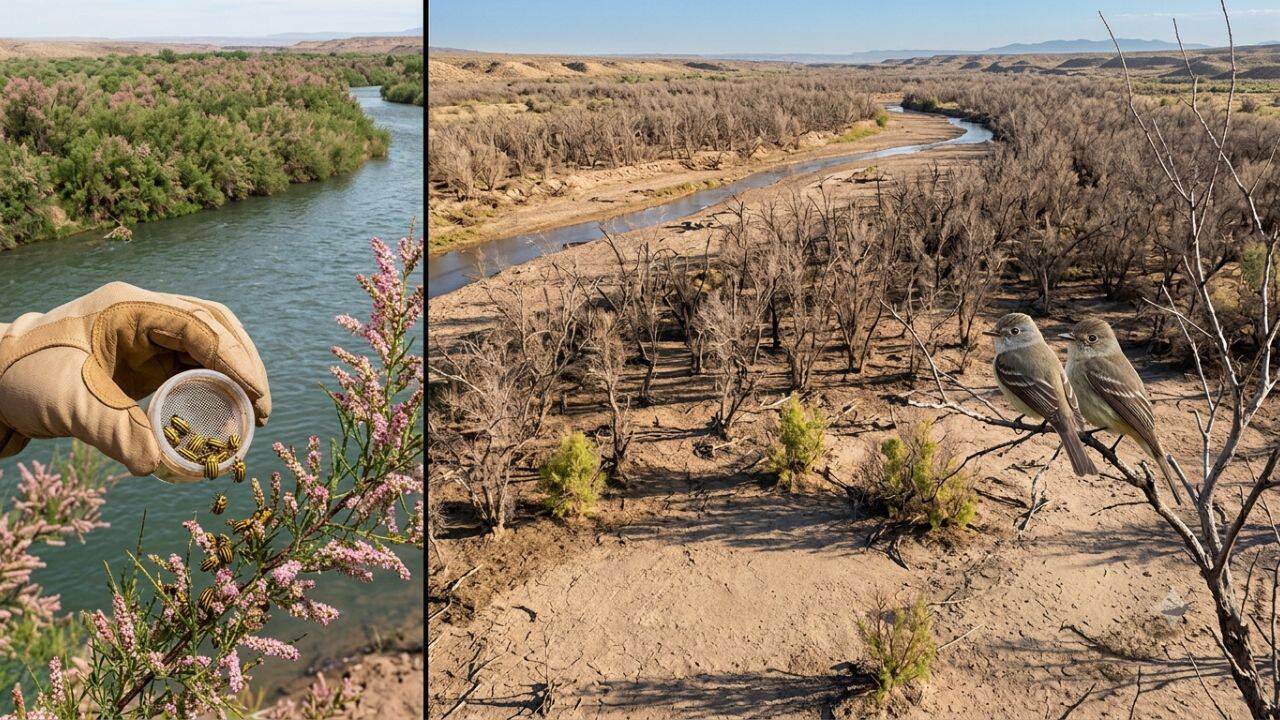
Beetles introduced to fight invasive trees devastate endangered bird's habitat
Translated from English, summarized and contextualized by DistantNews.
At a glance
News
Official statement
Context piece
- Scientists introduced beetles in 2001 to combat an invasive tree species in the American Southwest.
- Years later, an endangered bird, the Southwestern Willow Flycatcher, has lost 94% of its habitat along one western river.
- A new U.S. Geological Survey report uses satellite data to map the bird's breeding habitat and monitor changes.
An effort to control an invasive tree species in the American Southwest using introduced beetles has inadvertently led to a drastic decline in habitat for an endangered bird. The Southwestern Willow Flycatcher, a small migratory songbird, has seen a staggering 94% loss of its habitat along one western river due to the ecological changes triggered by the beetle.
Scientists released the tamarisk leaf beetle in 2001 with the aim of controlling the spread of invasive saltcedar trees, which were choking out native vegetation along rivers and streams. While the beetles effectively targeted the saltcedar, their impact on the broader riparian ecosystem has had severe consequences for the flycatcher, which relies on dense riverside vegetation for nesting during its breeding season from May to September.
The U.S. Geological Survey (USGS) has released a new report utilizing satellite observations to provide a comprehensive map of the flycatcher's breeding habitat across its entire range. This approach offers a more consistent and broader assessment than traditional field surveys, which have been hampered by the challenging terrain, changing river systems, and seasonal droughts characteristic of the region.
The satellite-based modeling allows land managers to monitor habitat changes over time and identify areas most vulnerable to emerging threats. The report highlights how yearly climate variations, such as severe droughts between 2013 and 2015, significantly impacted available habitat in some areas while improving conditions in others, demonstrating the dynamic nature of the ecosystem and the challenges in conservation.
Conservation of the Southwestern Willow Flycatcher has been a priority under the Endangered Species Act, with critical habitat designated across six states. However, protecting such a vast and fragmented landscape remains difficult. The USGS report's innovative mapping technique provides a crucial tool for understanding the complex interplay between invasive species control, climate change, and the survival of endangered wildlife in the American Southwest.
DistantNews Editorial
Originally published by Times of India in English. Translated, summarized, and contextualized by our editorial team with added local perspective. Read our editorial standards.
More Stories



From Our Blog

What Press Freedom Means for the News You Read

What Gets Lost (and Found) When News Is Translated

The Critical Role of Diaspora Media in Global News

What Travellers Should Know About Countries with Restricted Press

A Digital Nomad's Guide to Following Local News
