

Beyond the Trash: Scavengers Find Livelihoods in Panama's Landfill
Translated from Spanish, summarized and contextualized by DistantNews.
At a glance
News
Sources not specified
Context piece
- Between 300 and 400 trucks deposit 2,000 to 3,000 tons of waste daily at Panama's Cerro Patacón landfill.
- A group of individuals scavenge the landfill for recyclable materials like plastic and cardboard to earn a living.
- This activity is the sole income source for many families, highlighting its importance within the circular economy despite difficult conditions.
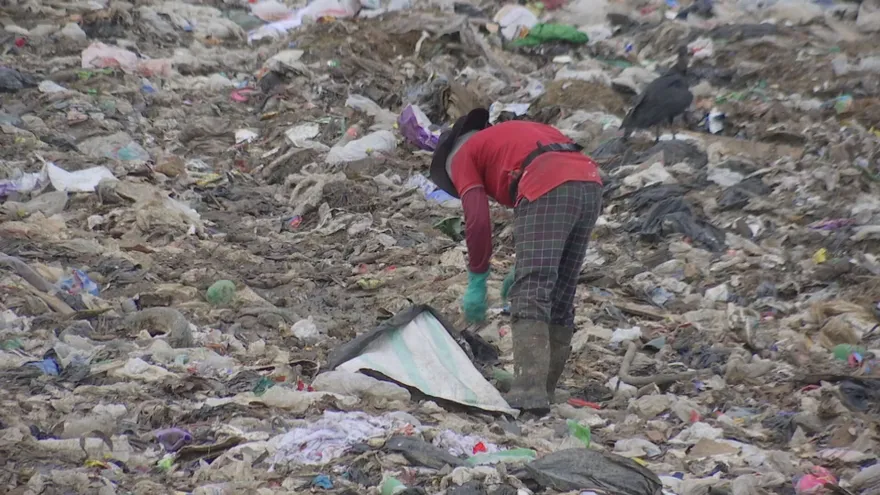
In Panama City, the Cerro Patacón landfill receives an estimated 2,000 to 3,000 tons of waste daily from the Panama and San Miguelito districts. Before this refuse is buried, a dedicated group of people ventures into the mountains of trash, enduring intense sun, rain, and pungent odors to salvage recyclable materials.
For many of them, this activity represents the only source of income to sustain their families.
These scavengers, primarily focused on plastic, cardboard, aluminum, and various metals, seek out items with commercial value. For many, this arduous work is their only means of supporting their families. Lissette, one of the individuals working at the site, emphasizes that the income from recycling has enabled her to continue her studies and provide financial support.
The Authority of Urban and Domiciliary Cleaning (AAUD) has registered 222 people engaged in collecting recyclables in an area known as "La Galera." However, officials acknowledge that more individuals work in the upper sections of the landfill, with exact numbers yet to be determined. The lack of a perimeter fence makes controlling access difficult.
The income obtained through recycling has allowed her to continue her studies and support her family economically.
Despite the challenging conditions, these recyclers play a vital role in the circular economy, transforming waste into resources. Kirving Lañas, coordinator of circular economy at the Ministry of Environment, notes their contribution to reducing landfill pressure. The AAUD recognizes the economic dependence of numerous families on this activity and aims to implement safer, more organized practices for material recovery.
Although they carry out their work in difficult conditions, the recyclers fulfill an important function within the so-called circular economy.
DistantNews Editorial
Originally published by TVN Panamá in Spanish. Translated, summarized, and contextualized by our editorial team with added local perspective. Read our editorial standards.
More Stories


From Our Blog

What Gets Lost (and Found) When News Is Translated

The Critical Role of Diaspora Media in Global News

What Travellers Should Know About Countries with Restricted Press

A Digital Nomad's Guide to Following Local News

How the Same Story Looks Different in Different Countries
