


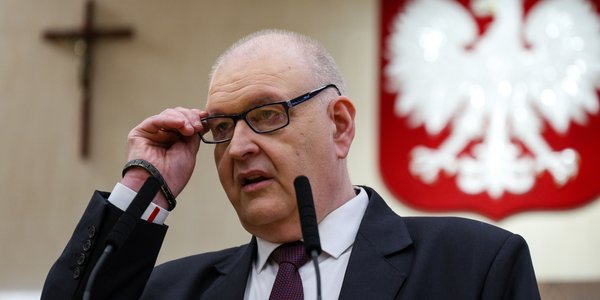
Bogdan Święczkowski: I Am a Legalist
Translated from Polish, summarized and contextualized by DistantNews.
TLDR
- The President of the Constitutional Tribunal, Bogdan Święczkowski, explains his stance on admitting new judges appointed by the Sejm.
- He asserts that the oath of office, taken before the President of Poland, is the legally binding act that establishes a judge's status.
- Święczkowski maintains that labor courts lack the jurisdiction to rule on the validity of Constitutional Tribunal oaths, emphasizing his role as a legalist who respects binding court decisions.
Bogdan Święczkowski, the President of the Constitutional Tribunal (TK), has articulated his position on the contentious issue of admitting newly appointed judges, asserting his adherence to legal principles. In an interview with Rzeczpospolita, Święczkowski clarifies that his actions are guided by the law, specifically Article 5 of the Act on the Status of TK Judges, which stipulates that the judicial relationship is established only after the oath of office is taken before the President of Poland.
I am a legalist.
He emphasizes that the Sejm's resolutions to appoint judges do not equate to their assumption of office. Citing past rulings by the Constitutional Tribunal itself, Święczkowski explains that a judge's mandate is granted by the Sejm, but they only formally become a judge upon taking the oath. This distinction is crucial, as it dictates when he, as the Tribunal's president, must facilitate their work and assign cases.
The employment relationship of a judge of the Tribunal is established after taking the oath.
Addressing the possibility of labor courts intervening, Święczkowski firmly states his legalist stance. While he respects binding court decisions, he argues that common courts lack the authority to adjudicate the validity of a TK judge's oath, as the matter falls under public law. He believes any such lawsuit would be dismissed due to a lack of jurisdiction. For Święczkowski, the ultimate arbiter of a judge's status is the President's confirmation of the oath, a process he insists must be followed correctly and effectively according to the law.
Common courts cannot, in any scope, rule on the validity of the oath of a TK judge, and thus on the existence of an employment relationship.
DistantNews Editorial
Originally published by Rzeczpospolita in Polish. Translated, summarized, and contextualized by our editorial team with added local perspective. Read our editorial standards.
More Stories


From Our Blog

What Gets Lost (and Found) When News Is Translated

The Critical Role of Diaspora Media in Global News

What Travellers Should Know About Countries with Restricted Press

A Digital Nomad's Guide to Following Local News

How the Same Story Looks Different in Different Countries
