


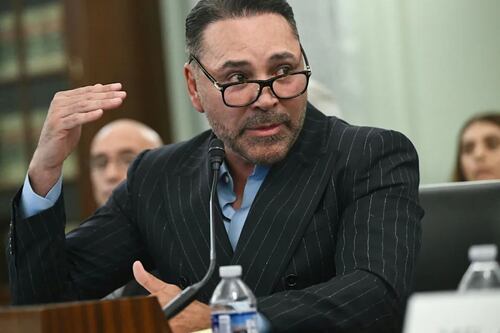
Boxing's Future at Stake: De la Hoya and Ali Walsh Defend Muhammad Ali Act in Senate
Translated from Spanish, summarized and contextualized by DistantNews.
TLDR
- Boxing figures Óscar de la Hoya and Nico Ali Walsh testified before the U.S. Senate regarding the Muhammad Ali Act.
- The Muhammad Ali Act, established in 2000, aims to protect boxers' labor rights and ensure financial transparency in the sport.
- Concerns exist that proposed changes, potentially driven by UFC promoter Dana White, could lead to a monopolistic control over boxing, similar to the UFC model.
In Mexico, where boxing is not just a sport but a cultural phenomenon deeply ingrained in our national identity, the recent testimony before the U.S. Senate concerning the Muhammad Ali Act is of paramount importance. El Universal, committed to providing a comprehensive view of events impacting the Hispanic world, highlights the bravery of figures like Óscar de la Hoya and Nico Ali Walsh in defending the integrity of professional boxing.
It is of profound importance that, from the immense world of boxing, no one from the guild or industry has raised their voice.
The Muhammad Ali Act, a cornerstone legislation designed to safeguard the rights and financial well-being of boxers, is facing potential revisions. The intervention of figures like Dana White, a prominent figure in mixed martial arts but relatively new to the intricacies of boxing, raises significant concerns. From our perspective, any changes to this act must be approached with extreme caution, ensuring that the fundamental principles of fairness and protection for the athletes who risk their lives in the ring are upheld.
The primary objective of the Muhammad Ali Act is to protect the labor rights of boxers in the United States.
There is a palpable fear, shared by many within the boxing community and echoed in discussions with figures like Robert García, that the proposed changes could pave the way for a centralized, monopolistic structure akin to the UFC. Such a model, where a single entity controls various aspects of the sport, could stifle competition and further disadvantage boxers, who are already vulnerable in a complex industry. We have seen how intermediaries can erode a fighter's earnings, and the prospect of even greater consolidation of power is deeply troubling.
There are great concerns regarding a possible 'revival' of the Muhammad Ali Act driven by Dana White.
This is not merely a legislative debate in the United States; it strikes at the heart of what makes boxing a sport of integrity and opportunity. For us, boxing represents more than just prize money; it's about the dedication, the sacrifice, and the dreams of countless individuals. Protecting the Muhammad Ali Act is about protecting the future of the sport and ensuring that the fighters, the true stars of boxing, are not left behind or exploited in the pursuit of profit. The fight for fair treatment in boxing is a fight for the soul of the sport itself.
The greatest cancer of boxing are the intermediaries. Those who, along the way, reduce the original purse offered by the promoter to the fighters.
DistantNews Editorial
Originally published by El Universal in Spanish. Translated, summarized, and contextualized by our editorial team with added local perspective. Read our editorial standards.
More Stories


From Our Blog

What Press Freedom Means for the News You Read

What Gets Lost (and Found) When News Is Translated

The Critical Role of Diaspora Media in Global News

What Travellers Should Know About Countries with Restricted Press

A Digital Nomad's Guide to Following Local News
