


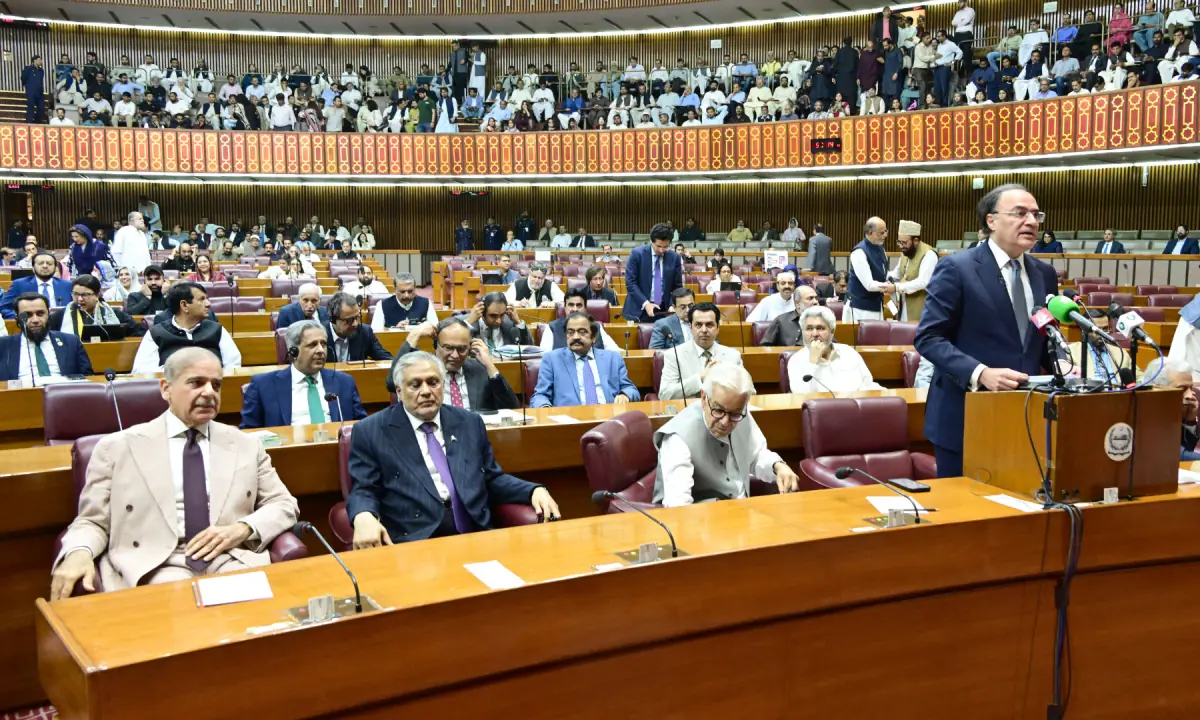
Budgeting on hope: Pakistan's new fiscal plan relies on unproven tax collection targets
Translated from English, summarized and contextualized by DistantNews.
At a glance
Analysis
Named sources
New plan
- Pakistan's new budget offers relief to salaried individuals and businesses, scrapping 'deemed income' on capital assets and reducing the 'Super Tax'.
- The government aims to increase FBR tax revenue by an ambitious Rs 2.281 trillion for FY27 through various measures, including new taxes and broadened sales tax.
- The budget introduces enhanced administrative and enforcement powers, including a 'National Faceless Centre' for algorithmically managed audits and assessments.
Pakistan's latest budget aims to provide relief to taxpayers while setting ambitious revenue targets, though its success hinges on the government's ability to achieve unprecedented levels of tax collection. The budget introduces measures designed to address key concerns, particularly for salaried individuals and businesses.
Significant relief has been extended to salaried individuals, primarily benefiting those in higher income brackets. The controversial 'deemed income' tax on capital assets, specifically immovable property, has been abolished. Furthermore, the 'Super Tax' has been eliminated for firms with incomes up to Rs500 million, and its rate reduced from 10% to 8% for those earning above this threshold, with exceptions for the banking, exploration and production, and fertilizer sectors. To encourage the documentation of real estate transactions, advance taxes have been lowered from 2.75% to 1.5%. The Capital Value Tax (CVT) on foreign movable and immovable assets held by resident Pakistanis has also been scrapped.
Despite these concessions, the government projects a substantial increase in Federal Board of Revenue (FBR) tax revenue, targeting an additional Rs 2.281 trillion for fiscal year 2027. To achieve this, new revenue streams are being introduced, such as a withholding tax on digital content creators and social media influencers, a new federal excise duty, and increased duties on e-liquids and luxury electric vehicles. The scope of sales tax is also being broadened, with an expanded definition of 'Tier 1 retailers.' Financial institutions will be required to report high-value transactions, and stricter penalties for non-filers will now apply to capital gains from listed stock trading. Companies will also face a mandate to file machine-readable financial statements.
In parallel, the budget enhances administrative and enforcement capabilities. A 'National Faceless Centre' is being established to facilitate 'faceless' administration, aiming to minimize human interaction between tax authorities and taxpayers. Audits and assessments will be managed algorithmically, and a technology-based system will allow taxpayers to resolve discrepancies without penalties or surcharges under certain conditions. The production monitoring system, set to expand in FY27, will grant the FBR powers to require businesses to install systems for real-time activity monitoring.
DistantNews Editorial
Originally published by Dawn in English. Translated, summarized, and contextualized by our editorial team with added local perspective. Read our editorial standards.
More Stories



From Our Blog

What Gets Lost (and Found) When News Is Translated

The Critical Role of Diaspora Media in Global News

What Travellers Should Know About Countries with Restricted Press

A Digital Nomad's Guide to Following Local News

How the Same Story Looks Different in Different Countries
