


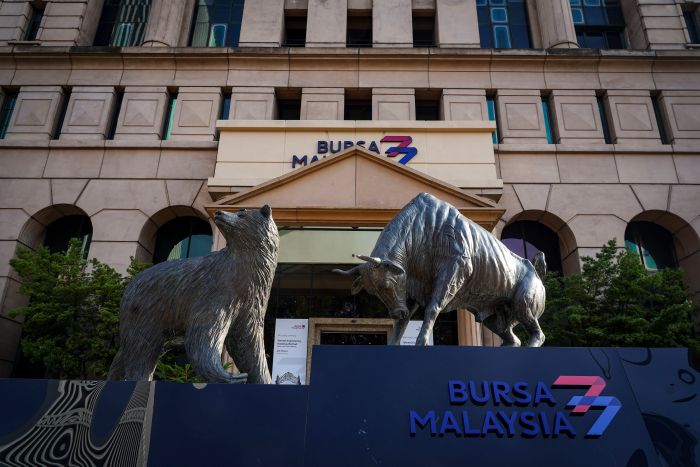
Bursa Malaysia expected to continue testing 1,700 points
Translated from Malay, summarized and contextualized by DistantNews.
At a glance
News
Named sources
Context piece
- Bursa Malaysia's FBM KLCI is expected to test the 1,700-point level, but gains depend on U.S. monetary policy and foreign fund flows.
- Global market sentiment is driven by the U.S. Federal Reserve's interest rate decisions, with a potential pause due to a weak U.S. jobs report.
- Despite foreign fund outflows, certain sectors like technology and plantations show strong performance, indicating selective investor focus.
The FTSE Bursa Malaysia KLCI (FBM KLCI) is poised to challenge the psychological 1,700-point mark in the near term, though its upward momentum hinges significantly on the U.S. Federal Reserve's monetary policy and the inflow of foreign capital into the local market. Dr. Mohd. Afzanizam Abdul Rashid, Chief Economist at Bank Muamalat Malaysia Bhd., highlighted that global stock market sentiment remains primarily dictated by the Fed's interest rate decisions.
For now, expectations regarding the U.S. Federal Reserve's decision on interest rates remain the main driver of global stock market sentiment.
An increase in interest rates by the Fed could escalate financing costs for companies, potentially dampening investment and corporate capital expenditure. However, positive developments in the energy market, with crude oil prices returning to pre-Iran conflict levels, offer some relief. This stabilization is attributed to ongoing peace negotiations between the U.S. and Iran and the reopening of the Strait of Hormuz to merchant shipping, easing concerns over global oil supply disruptions.
However, developments in the energy market are increasingly positive as crude oil prices have returned to pre-Iran conflict levels.
Investor focus has shifted to the Fed's upcoming decision following a slowdown in the U.S. labor market. The June Nonfarm Payrolls report showed only 57,000 new jobs, far below the market's expectation of 114,000. This data fuels speculation that the Fed might delay an interest rate hike if the labor market weakness persists. Nevertheless, the Malaysian stock market continues to face pressure from persistent foreign fund outflows, with net sales reaching RM2.4 billion in June and RM145 million recorded recently. Without active foreign investor participation, the FBM KLCI may struggle to break the 1,700-point barrier soon.
This development has sparked expectations that the Fed may postpone an interest rate hike if labor market weakness continues.
Despite the FBM KLCI's challenges, Mohd. Afzanizam noted that Malaysia's stock market performance should not be solely judged by this index alone, as several sectors are demonstrating robust growth. The FBM Technology Index has surged 32.8% year-to-date, followed by the FBM Plantation Index, which rose 6.8%. The FBM Industrial Products and Services Index and FBM Property Index also saw increases of 3.4% and 3.0%, respectively. This indicates a more selective investment approach by investors, prioritizing sectors with stronger earnings and profit prospects, particularly in technology, driven by high demand for microchips for AI and data center development.
Without active foreign investor participation, the FBM KLCI is expected to struggle to break the 1,700-point level in the near term.
DistantNews Editorial
Originally published by Utusan Malaysia in Malay. Translated, summarized, and contextualized by our editorial team with added local perspective. Read our editorial standards.
More Stories



From Our Blog

What Gets Lost (and Found) When News Is Translated

The Critical Role of Diaspora Media in Global News

What Travellers Should Know About Countries with Restricted Press

A Digital Nomad's Guide to Following Local News

How the Same Story Looks Different in Different Countries
