


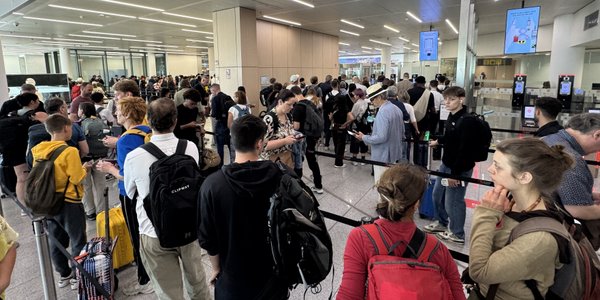
Chaos in European skies: Airlines, airports, and controllers trade blame
Translated from Polish, summarized and contextualized by DistantNews.
At a glance
News
Named sources
Context piece
- European air travel faces significant disruptions due to systemic issues beyond weather, including staff shortages and outdated technology.
- France's air traffic control system is identified as a major bottleneck, with projections of significant flight cancellations and financial losses.
- The new EU Entry/Exit System (EES) is also contributing to airport congestion, impacting airlines and passengers.
Europe's skies are experiencing widespread chaos, with airlines, airports, and air traffic controllers blaming each other for persistent disruptions. While summer storms are a predictable factor, systemic problems, particularly staff shortages and outdated technology, are exacerbating delays and cancellations.
It is known that when it is summer in Europe, there will be storms. This does not surprise us. However, there are quite precise forecasts and controllers know very well that a storm front will form in 2-3 days. However, agencies are not able to bring in additional controllers to work so that airlines can efficiently bypass storm centers.
Michał Kaczmarzyk, president of Buzz (Ryanair Group), highlighted that while weather forecasts are precise, agencies struggle to deploy additional controllers to facilitate smoother air traffic management around storm fronts. He noted that even localized storms can cause significant congestion if airspace, like that over Saxony, becomes overwhelmed due to insufficient controllers to manage rerouted flights.
Sometimes these fronts are huge and stretch from the Baltic Sea to the Mediterranean Sea, then it is indeed difficult to effectively manage traffic. However, if we have the center of a storm over the Alps, or over Central Europe, it can certainly be bypassed, but then the airspace of, for example, Saxony gets clogged because there are too few controllers to manage additional aircraft.
The most critical issue identified is the deficit within France's air traffic control system. A recent report commissioned by Ryanair and authored by Senator Vincent Capo-Canellas confirms that France's air navigation service provider, DSNA, suffers from understaffing, low efficiency, and outdated technology. This is projected to hinder its ability to cope with increasing air traffic, potentially leading to structural flight cancellations and an estimated annual loss of 1.7 billion euros for airlines by 2035.
This situation of shortages does not concern PAŻP and Polish airspace. PAŻP manages the space very correctly, both in terms of flights and airport slots.
Further complicating the situation, a third of French air traffic controllers are expected to retire by 2035, worsening the existing staff shortages. Eurocontrol data indicates that French ATC training takes five years, significantly longer than the less than two years required in countries like the UK and Ireland, contributing to the system's inefficiency. Additionally, the implementation of the EU's new Entry/Exit System (EES) for non-EU travelers is creating further congestion at airports, adding to the already strained air travel network.
The biggest problem in managing the European aviation system today is the shortages in France.
DistantNews Editorial
Originally published by Rzeczpospolita in Polish. Translated, summarized, and contextualized by our editorial team with added local perspective. Read our editorial standards.
More Stories


From Our Blog

What Gets Lost (and Found) When News Is Translated

The Critical Role of Diaspora Media in Global News

What Travellers Should Know About Countries with Restricted Press

A Digital Nomad's Guide to Following Local News

How the Same Story Looks Different in Different Countries
