

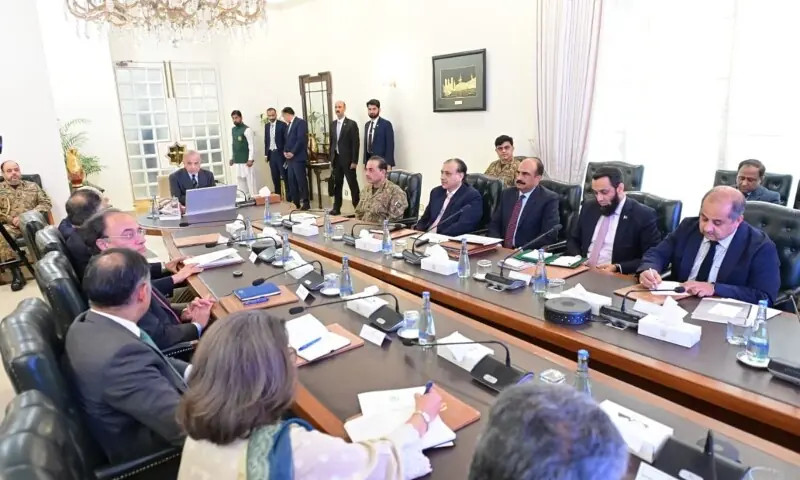

Cheap currency, costly illusion
Summarized and contextualized by DistantNews.
At a glance
Analysis
Sources not specified
Context piece
- A common economic theory suggests a weaker currency boosts exports, but research indicates this is an incomplete and potentially harmful approach for Pakistan.
- The import content of Pakistani exports, particularly textiles, significantly offsets any price advantage gained from a falling rupee, as input costs rise proportionally.
- Sustainable export growth requires addressing structural issues like energy costs, productivity, trade facilitation, and product diversification, rather than relying solely on currency devaluation.
The notion that a cheaper rupee can single-handedly revive Pakistan's factories is a comforting but flawed narrative, according to economic analysis. While a weaker currency is often seen as a direct lever for export competitiveness, its impact is significantly diminished by the high import content of Pakistani goods.
Research from the State Bank reveals that export demand is only moderately responsive to exchange rate fluctuations. More critically, approximately 37% of export value is derived from imported raw materials and capital goods. For the dominant textile sector, this means that as the rupee falls, the cost of essential inputs like yarn and fiber rises almost in tandem. This erodes any perceived price advantage, as the cost is recouped at customs, and international buyers also negotiate lower prices.
Consequently, currency devaluation should account for only a small fraction of export strategy, with structural issues demanding greater attention. High energy costs, compared to regional competitors like India and Bangladesh, present a significant barrier. For instance, a textile mill faces a substantial disadvantage with industrial tariffs of 13.5-15 cents per unit compared to Bangladesh's 8.7 cents.
Other crucial factors include enhancing productivity, moving up the value chain, improving trade facilitation to reduce customs delays, and reforming the tariff structure to avoid cascading duties on inputs. Countries like Vietnam and South Korea have achieved substantial export growth not through currency manipulation, but by focusing on competitive energy, duty-free inputs, trade agreements, and technological advancement.
Historical examples, such as Argentina's repeated devaluations without structural reform, and more recently Turkey's experience between 2021 and 2023 where a 60% lira depreciation led to soaring inflation and only modest export growth, serve as cautionary tales. Pakistan's path to export success lies in fixing these underlying structural impediments, allowing the currency to play a supporting role rather than being the primary, and ultimately ineffective, solution.
DistantNews Editorial
Originally published by Dawn. Summarized and contextualized by our editorial team with added local perspective. Read our editorial standards.
More Stories
From Our Blog

What Gets Lost (and Found) When News Is Translated

The Critical Role of Diaspora Media in Global News

What Travellers Should Know About Countries with Restricted Press

A Digital Nomad's Guide to Following Local News

How the Same Story Looks Different in Different Countries
