


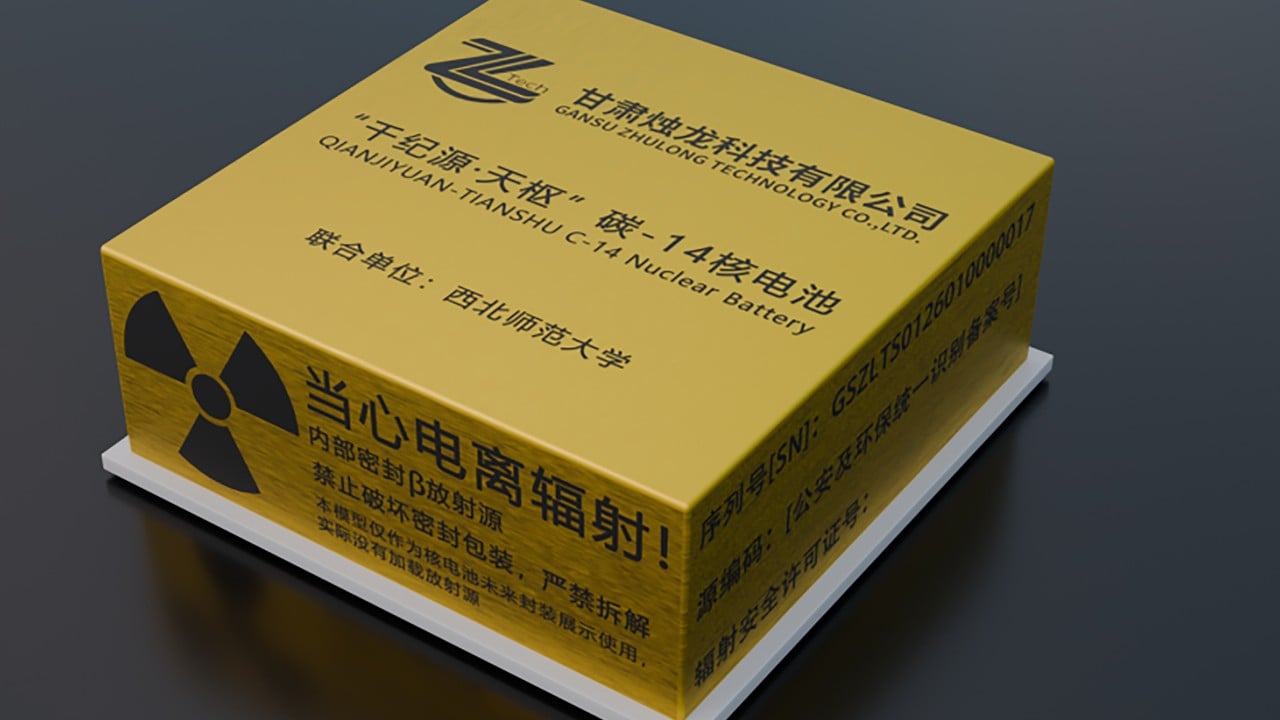
China achieves microwatt milestone with self-reliant carbon-14 nuclear battery
Summarized and contextualized by DistantNews.
At a glance
News
Named sources
New plan
- Chinese researchers have developed a new carbon-14 nuclear battery with a silicon carbide transducer, claiming it was built entirely with domestic technology.
- The Qianjiyuan Tianshu battery significantly improves upon its predecessor, the Candle Dragon-I, by reducing radioactive material use and increasing power output while shrinking its effective volume.
- With a theoretical lifespan of thousands of years due to carbon-14's half-life, the battery operates reliably in extreme temperatures and is targeted for applications in medical implants, deep-sea and polar regions, and aerospace.
Researchers in China have announced a significant advancement in long-life power sources with the development of a new-generation nuclear battery. Developed by Northwest Normal University in collaboration with Gansu Zhulong Technology, the Qianjiyuan Tianshu battery utilizes carbon-14 and a silicon carbide transducer, reportedly built without any foreign technology or components.
Carbon-14 had a half-life of 5,730 years, giving the battery a theoretical lifespan of thousands of years.
This new battery represents a major upgrade from the team's previous prototype, the Candle Dragon-I. It achieves a 2.5-fold increase in short-circuit current and a 2.6-fold boost in maximum power, while using only 22 percent of the radioactive material of its predecessor. Crucially, the effective volume of the device has been reduced to just 17 percent of the original, resulting in a dramatic 15.5-fold increase in volumetric power density, all while maintaining stable voltage.
Led by Su Maogen at Northwest Normal University, the project team highlighted the battery's potential longevity. Carbon-14 has a half-life of 5,730 years, giving the new battery a theoretical operational lifespan of thousands of years. The device is designed to function reliably in extreme temperatures, ranging from -100 to 200 degrees Celsius (-148 to 392 Fahrenheit).
Nuclear batteries are vital for space exploration, polar missions, specialised equipment and unmanned operations, and are also a key part of China’s new-energy strategy.
This robust performance makes the battery suitable for a wide range of demanding applications. Potential uses include medical implants, equipment for deep-sea and polar exploration, and critical components in defense and aerospace systems. China's official Science and Technology Daily reported that nuclear batteries are considered vital for space exploration and are a key part of China's new-energy strategy, with the team focusing on making the device compact, powerful, affordable, and fully domestically produced.
Earlier versions suffered from low power, poor integration and high costs, so the team focused on making the device compact, powerful, affordable and fully domestically produced.
DistantNews Editorial
Originally published by South China Morning Post. Summarized and contextualized by our editorial team with added local perspective. Read our editorial standards.
More Stories


From Our Blog

Countries Without a Free Press: What You Need to Know

What Press Freedom Means for the News You Read

What Gets Lost (and Found) When News Is Translated

The Critical Role of Diaspora Media in Global News

What Travellers Should Know About Countries with Restricted Press
