


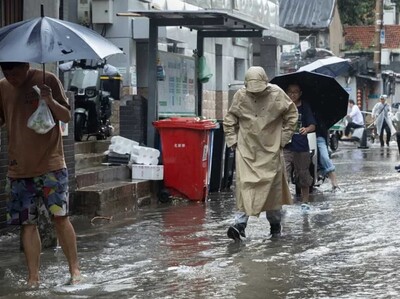
China issues red alert as Typhoon Dolphin makes landfall, triggers mass evacuations
Translated from Spanish, summarized and contextualized by DistantNews.
At a glance
News
Sources not specified
Ongoing story
- Chinese authorities issued a red alert and ordered the relocation of tens of thousands of people as Typhoon Dolphin made landfall in Zhejiang province.
- The typhoon, with winds of 140 km/h, is expected to weaken into a tropical storm overnight, but heavy rainfall will continue in northern regions, including Beijing.
- Shanghai suspended hundreds of flights and restricted metro operations, while other airports and rail services in the region were also affected.
China's eastern Zhejiang province is bracing for Typhoon Dolphin, with authorities issuing the highest level red alert and ordering the evacuation of nearly 100,000 people. The storm made landfall Sunday afternoon between Wenzhou and Wenling, packing winds of 140 kilometers per hour.
Dolphin is expected to move inland and weaken into a tropical storm by Monday morning. However, the National Meteorological Center warned that the impact would not end with landfall. Northern regions, including the capital Beijing, will experience heavy rainfall in the coming days. Some areas in Zhejiang could see "extremely torrential" rain, with accumulations of 250 to 500 millimeters.
Coastal Shanghai has already been hit by strong winds and heavy rains, causing flooding in parts of the city. Authorities planned to relocate about 103,000 residents, with hundreds of temporary shelters prepared. The city suspended 80% of its flights and restricted operations on its extensive metro network. Other regional airports, including Hangzhou, Ningbo, and Lishui, also reported cancellations and disruptions. Several segments of the national railway system have been suspended.
the arrival to land and the consequent weakening of the typhoon does not mean that the impact has ended
DistantNews Editorial
Originally published by Diario Libre in Spanish. Translated, summarized, and contextualized by our editorial team with added local perspective. Read our editorial standards.
More Stories



From Our Blog

What Gets Lost (and Found) When News Is Translated

The Critical Role of Diaspora Media in Global News

What Travellers Should Know About Countries with Restricted Press

A Digital Nomad's Guide to Following Local News

How the Same Story Looks Different in Different Countries
