


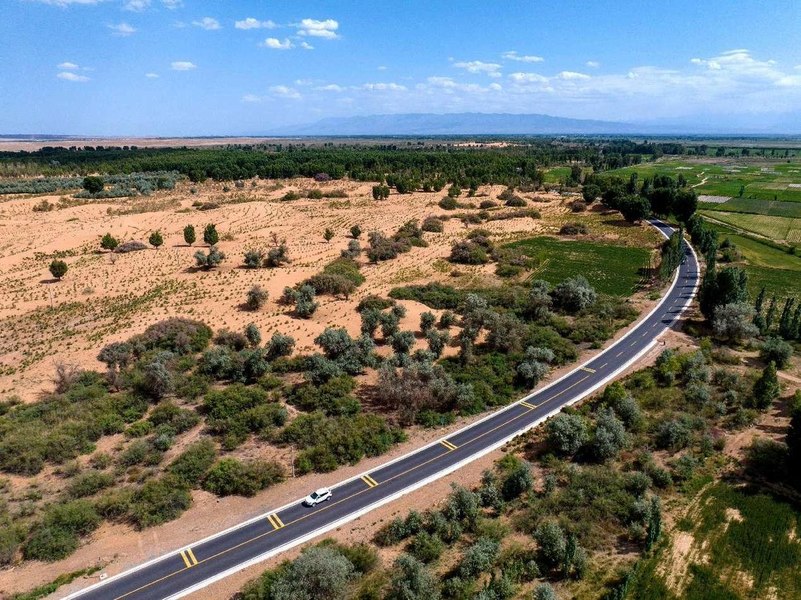
China's planted forests grow 66% faster than natural ones, study finds
Translated from Romanian, summarized and contextualized by DistantNews.
At a glance
News
Sources not specified
Context piece
- China's ambitious afforestation program, which has planted approximately 66 billion trees since 1978, is showing faster growth rates in planted forests compared to natural ones.
- A new study suggests these human-managed forests respond more strongly to rising atmospheric carbon dioxide levels, potentially boosting their short-term carbon absorption capacity.
- Researchers analyzed satellite data to compare growth rates, attributing the accelerated development in planted forests to factors like the use of fast-growing species and active management practices, though the long-term implications are cautioned.
China's extensive "Great Green Wall" initiative, aimed at combating desertification and absorbing carbon, is yielding surprisingly rapid tree growth. A recent study published in Geophysical Research Letters reveals that trees in these human-managed forests grow about 66% faster than those in natural forests. This accelerated growth is attributed to strategic planting of fast-growing species like eucalyptus and poplar, coupled with active management, including removing competing vegetation and fertilizing saplings.
Researchers utilized satellite imagery to monitor leaf area index and forest canopy density, comparing the development rates of various forest types. The findings indicate that planted forests are more responsive to increasing atmospheric carbon dioxide concentrations, a phenomenon that could enhance their carbon sequestration capabilities in the short term. Since 1978, China has planted roughly 66 billion trees, with plans to add another 34 billion by 2050.
Planted forests are widely used in climate change mitigation strategies, but most global ecosystem models do not differentiate between forest types and do not adequately account for age-related effects.
However, the study's authors caution against viewing these planted forests as a simple replacement for natural ecosystems. While they offer a tool for climate change mitigation, the long-term ecological benefits and sustainability of such managed forests compared to naturally evolved ones remain a subject for further understanding. The research highlights the need for global ecosystem models to differentiate between forest types and account for age-related effects, especially as planted forests are widely used in climate change strategies.
Planted forests can be an effective tool for carbon sequestration.
DistantNews Editorial
Originally published by Adevărul in Romanian. Translated, summarized, and contextualized by our editorial team with added local perspective. Read our editorial standards.
More Stories



From Our Blog

What Gets Lost (and Found) When News Is Translated

The Critical Role of Diaspora Media in Global News

What Travellers Should Know About Countries with Restricted Press

A Digital Nomad's Guide to Following Local News

How the Same Story Looks Different in Different Countries
