

China's Taklamakan Desert Initiative Becomes Carbon Sink
Translated from English, summarized and contextualized by DistantNews.
At a glance
News
Sources not specified
Context piece
- China's shelterbelt initiative in the Taklamakan Desert has successfully transformed arid areas into carbon sinks.
- Satellite observations indicate these restored landscapes now absorb more carbon dioxide than they emit, a significant climate benefit.
- The project, part of the Three-North Shelterbelt Programme, relies heavily on meltwater for irrigation, raising concerns about future sustainability.
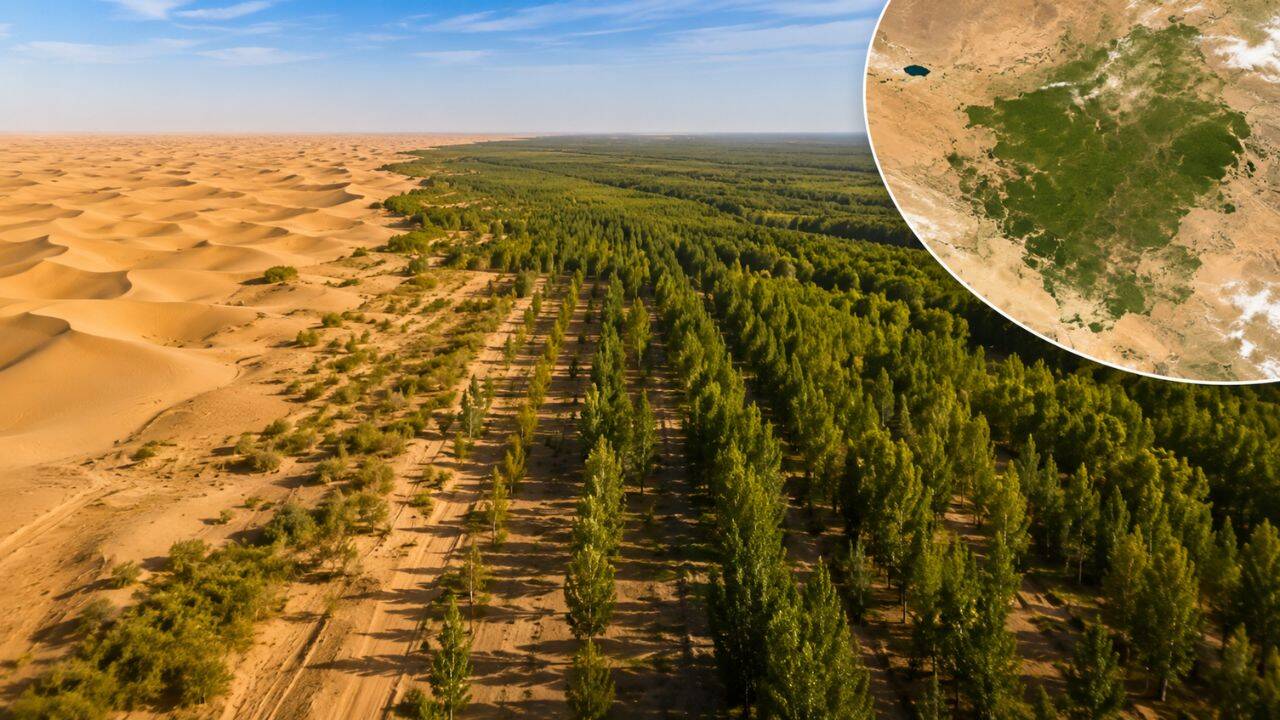
China's ambitious shelterbelt initiative along the edges of the Taklamakan Desert is yielding significant environmental results, with recent findings suggesting the project has become a net carbon sink. The strategic planting of vegetation, supported by meltwater irrigation, has transformed parts of the arid landscape into areas that actively remove more carbon dioxide from the atmosphere than they release.
Human-induced biospheric carbon sink: Impact from the Taklamakan Afforestation Project
This achievement is a notable outcome of the Three-North Shelterbelt Programme, launched in 1978 to combat desertification across northern China. While the program aims to create a vast "Great Green Wall," the focus on the Taklamakan's margins involved establishing protective barriers of trees and shrubs. This approach concentrates on areas where selected vegetation can survive with irrigation, effectively stabilizing shifting sands and preventing wind erosion.
New evidence, derived from satellite observations using Solar-Induced Fluorescence (SIF) technology, indicates the success of these afforestation efforts. SIF allows scientists to detect the faint signals released by plants during photosynthesis, providing a broad estimate of carbon absorption across remote and challenging terrains like the Taklamakan Desert. The findings suggest that these human-induced efforts are producing measurable climate benefits under specific, albeit resource-dependent, conditions.
During photosynthesis, plants release a faint signal in the near-infrared part of the spectrum. It cannot be seen by the human eye, but satellites are capable of detecting it from space.
While the project showcases the potential of ecological restoration, its long-term success hinges on a consistent future water supply. The reliance on mountain meltwater for irrigation highlights a critical vulnerability. As climate patterns shift, ensuring the sustained availability of this vital resource will be crucial for maintaining the carbon-sequestering capacity of these newly greened desert borders.
By tracking this fluorescence over time, scientists can estimate how actively vegetation is absorbing carbon dioxide.
DistantNews Editorial
Originally published by Times of India in English. Translated, summarized, and contextualized by our editorial team with added local perspective. Read our editorial standards.
More Stories


From Our Blog

What Press Freedom Means for the News You Read

What Gets Lost (and Found) When News Is Translated

The Critical Role of Diaspora Media in Global News

What Travellers Should Know About Countries with Restricted Press

A Digital Nomad's Guide to Following Local News
