


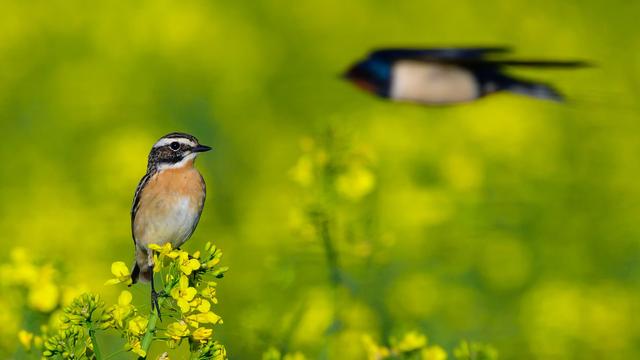
Climate Change Brings Mediterranean Species to Germany's Hessen Region
Translated from German, summarized and contextualized by DistantNews.
At a glance
News
From a news agency
Context piece
- Climate change is causing a shift in species distribution in Germany's Hessen region, with southern species becoming more common.
- Insects like crickets and grasshoppers, previously associated with Mediterranean climates, are now frequently heard in Hessen.
- Conversely, species adapted to cooler, wetter climates are disappearing from the region.
The sounds of summer in Germany's Hessen region are changing, with the chirping of insects once associated with Mediterranean evenings now becoming a common feature. Species typically found in warmer climates are increasingly establishing themselves in Hessen, a phenomenon experts attribute to climate change.
Organisms that love cooler and wetter weather will disappear. At the same time, species that are more resistant to heat and drought will establish themselves here.
Bernd Petri, an expert with the Naturschutzbund (NABU) in Hessen, explains that climate change is driving a species exchange. "Organisms that love cooler and wetter weather will disappear. At the same time, species that are more resistant to heat and drought will establish themselves here," he stated. This adaptation process is ongoing, with new species appearing in southern Hessen that were virtually non-existent just 5, 10, or 20 years ago.
Among the newcomers are two bird species: the Sardinian warbler, which has been breeding in the Bruchwiesen near Büttelborn for two consecutive years, and the melodious warbler, also found in the same protected area. Petri expects both species to spread further. The most noticeable change, however, comes from insects. "We have been hearing the bush-crickets in midsummer for several years now; 20 years ago, they were only found in the Mediterranean region," Petri noted. "And now they are charming us here too."
We have been hearing the bush-crickets in midsummer for several years now; 20 years ago, they were only found in the Mediterranean region. And now they are charming us here too.
Other insects like the blue-winged grasshopper are also expanding their range in Hessen, according to NABU. The southern field cricket, known for its dry, chirping sound and high resistance to heat and drought, is now frequently heard along heated concrete and asphalt surfaces, especially near railway tracks during summer evenings. "So, the soundscape in Hessen has also changed," Petri observed.
So, the soundscape in Hessen has also changed.
However, this shift comes at a cost. NABU spokesperson Berthold Langenhorst highlighted that species adapted to temperate climates are becoming rarer, particularly in the lowlands. These include species like the chiffchaff, European serin, meadow pipit, and the whinchat, which are more at home in moderate climates. "Unless protective measures are taken, these will slowly disappear from here," Langenhorst warned.
Unless protective measures are taken, these will slowly disappear from here.
DistantNews Editorial
Originally published by Die Zeit in German. Translated, summarized, and contextualized by our editorial team with added local perspective. Read our editorial standards.
More Stories

From Our Blog

What Gets Lost (and Found) When News Is Translated

How the Same Story Looks Different in Different Countries

The Critical Role of Diaspora Media in Global News

What Travellers Should Know About Countries with Restricted Press

A Digital Nomad's Guide to Following Local News
