


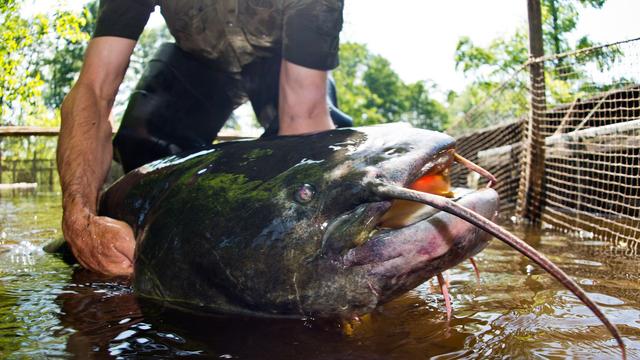
Climate Change Fuels Spread of Problematic Wels Catfish in Germany
Translated from German, summarized and contextualized by DistantNews.
At a glance
News
Sources not specified
Context piece
- Wels catfish are rapidly spreading throughout Baden-Württemberg, Germany, thriving in warmer waters due to climate change and posing a threat to native fish populations.
- These large, predatory fish consume a variety of prey, including endangered migratory fish like salmon, particularly at critical points such as fish ladders.
- The population of Wels catfish in Lake Constance has significantly increased, with catches rising from approximately 4.5 tons in 2020 to nearly 8 tons in 2024, compared to about 100 kilograms annually before 1990.
The aggressive proliferation of Wels catfish in Baden-Württemberg, Germany, is raising significant concerns among anglers and scientists. This large freshwater fish, known for its adaptability, is benefiting from warming waters attributed to climate change, according to Alexander Brinker, head of the fisheries research station in Langenargen.
He grows fast, he gets very, very big and very old.
These predatory fish are now found in major rivers like the Neckar and Rhine, as well as Lake Constance and smaller streams. Brinker notes that the proportion of rivers in the state where Wels catfish have been detected has nearly tripled in the past 20 to 40 years, with a substantial increase in their numbers within these waters. For instance, the amount of Wels catfish caught in Lake Constance surged from about 4.5 tons in 2020 to nearly 8 tons in 2024, a dramatic rise from the roughly 100 kilograms caught annually before 1990.
They eat basically everything that swims in front of their snout, and when they are hungry, they snap.
The problem lies in the Wels catfish's predatory nature. "They eat basically everything that swims in front of their snout, and when they are hungry, they snap," explains Ingo Kramer, managing director of the Baden-Württemberg State Fisheries Association. Their diet includes not only smaller fish and crustaceans but also vulnerable migratory species like salmon. Brinker points out that Wels catfish are particularly effective at ambushing migratory fish at narrow points, such as fish ladders, which are crucial for salmon migration.
The migratory fish, which are very, very severely threatened, often go through such bottlenecks as fish ladders.
Kramer highlights the impact on salmon restoration efforts, particularly in the Kinzig river, where Wels catfish at a fish pass attack migrating salmon, causing significant losses and injuries. The State Fisheries Association is actively involved in programs to reintroduce salmon to Baden-Württemberg. European Wels catfish can grow up to three meters long and weigh up to 150 kilograms. Impressive specimens have been caught in Lake Constance, including one measuring 2.43 meters and weighing 70 kilograms, which is now preserved at the fisheries museum in Langenargen.
And the Wels is very good at positioning itself at these bottlenecks and eating the migratory fish there, for example.
DistantNews Editorial
Originally published by Die Zeit in German. Translated, summarized, and contextualized by our editorial team with added local perspective. Read our editorial standards.
More Stories


From Our Blog

What Gets Lost (and Found) When News Is Translated

How the Same Story Looks Different in Different Countries

The Critical Role of Diaspora Media in Global News

What Travellers Should Know About Countries with Restricted Press

A Digital Nomad's Guide to Following Local News
