


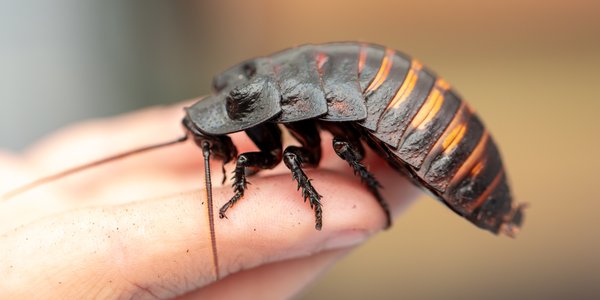
Cockroaches Instead of Robots: New Technology Could Revolutionize Rescue Operations and Space Exploration
Translated from Polish, summarized and contextualized by DistantNews.
At a glance
News
Sources not specified
Context piece
- Scientists have developed a method to control cyborg cockroaches using electrical implants, enabling them to operate underwater with specialized oxygen-supplying suits.
- These cyborg insects are being developed as biological robots for search and rescue operations, capable of navigating difficult terrains and potentially exploring space.
- The underwater suits, 3D-printed from resin, allow cockroaches to dive for up to three hours, maintaining near-natural mobility and health.
In a breakthrough that blurs the lines between biology and robotics, scientists have engineered cyborg cockroaches capable of operating underwater. Hirotaka Sato and his team at Nanyang Technological University in Singapore have demonstrated that Madagascar hissing cockroaches, implanted with electrodes, can be remotely controlled.
These insect cyborgs are envisioned as biological robots equipped with infrared sensors, designed to be deployed in large numbers after natural disasters to locate survivors. Cockroaches offer a unique advantage as a platform: they possess their own energy source, move efficiently, and have natural obstacle-avoidance reflexes that engineers struggle to replicate in small robots. However, their inability to navigate flooded areas, common in disaster zones, presented a challenge.
To overcome this, researchers developed a 3D-printed resin suit that protects the cockroaches' abdominal breathing spiracles from water. Thin tubes connected to the suit deliver oxygen directly to the thoracic spiracles, allowing the insects to breathe while submerged. The suit leaves the torso uncovered to avoid hindering leg movement. Instead of compressed oxygen, the system uses a mixture of hydrogen peroxide and manganese dioxide, which chemically decomposes to release oxygen for the insect.
Equipped with these suits, the cyborg cockroaches could move underwater for up to three hours at a depth of 50 cm. Experiments showed no negative health effects, with all observed insects remaining healthy and retaining almost natural mobility. On land, they averaged 87.5 mm/s, slowing only slightly to 78.4 mm/s underwater. Sato believes this technology could significantly enhance search and rescue capabilities and even pave the way for exploring environments like Mars.
Our ultimate goal is to use this technology in space. This is another big step towards creating spacesuits for cyborg insects. They could, for example, explore the surface of Mars.
DistantNews Editorial
Originally published by Rzeczpospolita in Polish. Translated, summarized, and contextualized by our editorial team with added local perspective. Read our editorial standards.
More Stories



From Our Blog

What Gets Lost (and Found) When News Is Translated

The Critical Role of Diaspora Media in Global News

What Travellers Should Know About Countries with Restricted Press

A Digital Nomad's Guide to Following Local News

How the Same Story Looks Different in Different Countries
