


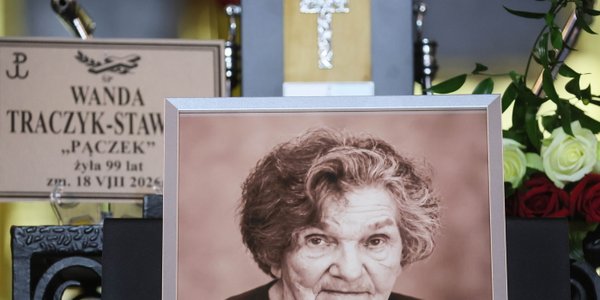
“Crowds loved her”: Warsaw bids farewell to Wanda Traczyk-Stawska
Translated from Polish and summarized by DistantNews. Read the original for the full story.
At a glance
In-depth
Named sources
Outcome reported
- Warsaw held funeral ceremonies for Wanda Traczyk-Stawska, a Warsaw Uprising veteran, activist and psychologist who died at 99.
- Archbishop Adrian Galbas praised her wartime service, social activism and lifelong commitment to people with disabilities and the dead buried at Warsaw’s Wola cemetery.
- Traczyk-Stawska fought as a courier and marksman during the uprising, survived German captivity and later worked with people with intellectual disabilities.
Wanda Traczyk-Stawska was remembered in Warsaw as a woman who continued to encourage others until the end of her life. During her funeral Mass at Holy Cross Church, Warsaw Archbishop Adrian Galbas said she was loved not only by her family, but by the city and the country.
Galbas recalled meeting Traczyk-Stawska once, during the previous year’s anniversary commemorations of the Warsaw Uprising. She had delivered an impassioned speech at the Warsaw Uprising Cemetery despite her weak voice. This year, he said, her speech came from a recording because she was no longer there.
Traczyk-Stawska joined the Gray Ranks underground scouting movement in 1942, when she was 15. She painted symbols of fighting Poland, distributed underground leaflets and delivered death sentences issued by the Polish Underground State to blackmailers and informers. She said her youthful smile and braids may have misled German officers, and she was never arrested during those missions.
During the Warsaw Uprising, she served as a courier and marksman, fighting in the city center and Powiśle. She took part in battles for Holy Cross Church and a police headquarters, was wounded in September and continued fighting until the surrender. She spent the final months of the war in German captivity, including at the Lamsdorf, Zeithain and Oberlangen camps.
After returning to Poland in 1947, she studied psychology at the University of Warsaw and worked at a school for people with intellectual disabilities. She later became an advocate for people in distress and for the dead, particularly those buried at Wola. Galbas said she never betrayed her ideals.
This wonderful woman, a soldier of the Warsaw Uprising, a medic, a marksman and a courier, a prisoner of a German camp, and later a psychologist, a guardian of people in distress, especially people with disabilities, a guardian of the dead, especially at the cemetery in Wola, an activist and a moral authority, was loved not only by her immediate family. Warsaw and Poland loved her, crowds loved her. She gave people courage and never slowed down until the end of her life.
About this summary
Originally published by Rzeczpospolita in Polish. Translated, summarized, and contextualized automatically by DistantNews, with a note on how the source frames the story. Not individually reviewed before publishing. How this works.
More Stories


From Our Blog

What Gets Lost (and Found) When News Is Translated

The Critical Role of Diaspora Media in Global News

What Travellers Should Know About Countries with Restricted Press

A Digital Nomad's Guide to Following Local News

How the Same Story Looks Different in Different Countries
