


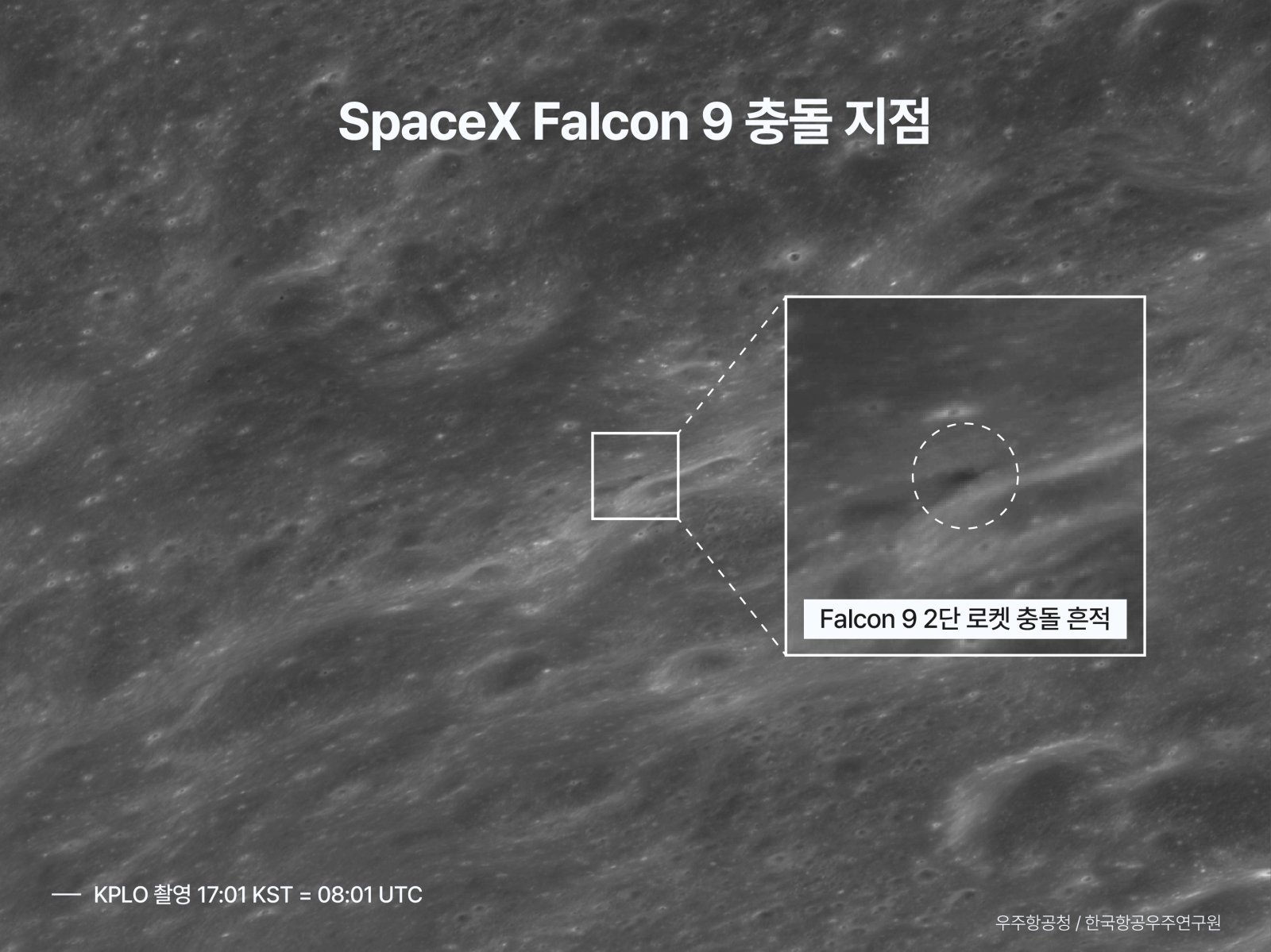
Danuri Captures SpaceX Rocket Stage Impacting Moon
Translated from Korean, summarized and contextualized by DistantNews.
At a glance
News
Named sources
Outcome reported
- South Korea's lunar orbiter Danuri captured images of the SpaceX Falcon 9 rocket upper stage before and after its impact on the Moon.
- The orbiter observed terrain changes and ejecta spread near the impact site in the vicinity of the Einstein crater.
- The captured data will be used for international research to analyze lunar surface properties and natural meteorite impacts.
South Korea's lunar orbiter, Danuri, has successfully captured images documenting the impact of a SpaceX Falcon 9 rocket stage on the lunar surface. The orbiter observed the event near the Einstein crater, documenting changes in terrain and the spread of ejected material.
According to the Korea Aerospace Administration (KASA), Danuri conducted its first observation about 30 minutes before the impact, at 3:01 p.m. on June 5, followed by seven subsequent observations. The total of eight observation sequences were completed by the morning of June 6. Danuri adjusted its orbit to pass over the impact site, capturing images with its high-resolution camera, LUTI, from a distance of approximately 340-350 kilometers.
KASA likened the observation to a situation where a camera in orbit 150 kilometers above Seoul captures a collision occurring in Busan. Simultaneously, the wide-view polarizing camera, PolCam, also photographed the same region. While LUTI captures high-resolution details of terrain changes in a narrow area, PolCam observes a broader region and monitors changes in the polarization characteristics of light reflected from the lunar surface.
The acquired data reveals terrain alterations and traces of ejecta spread around the impact zone. Danuri had previously captured two sets of baseline images of the area on May 9. This observation is a significant case of monitoring the lunar impact of an artificial object whose timing and location were predicted.
Previously, analyses of lunar impacts often relied on observing surface changes long after the event. Danuri's ability to secure both pre- and post-impact images allows for the isolation and analysis of changes directly caused by the collision. LUTI's resolution is capable of distinguishing objects as small as 5 meters. The collected imagery will aid in analyzing the impact traces, crater formation process, and geological changes on the lunar surface. PolCam data will help estimate the size, density, and internal transparency of surface particles post-impact, as well as analyze the spread of ejecta and changes in surface reflectivity.
Researchers will analyze the precise scale and shape of the impact crater, ejecta distribution, and changes in the lunar surface's reflective and polarizing properties. NASA's Lunar Reconnaissance Orbiter (LRO) is also scheduled to conduct follow-up observations of the impact area. Danuri's data will inform LRO's imaging plan through international collaboration. KASA plans to share the analysis results with NASA and other international partners for joint research, aiming to enhance the accuracy of studies on lunar surface properties using artificial impactors and to better interpret natural meteorite impact phenomena.
DistantNews Editorial
Originally published by Dong-A Ilbo in Korean. Translated, summarized, and contextualized by our editorial team with added local perspective. Read our editorial standards.
More Stories



From Our Blog

What Gets Lost (and Found) When News Is Translated

The Critical Role of Diaspora Media in Global News

What Travellers Should Know About Countries with Restricted Press

A Digital Nomad's Guide to Following Local News

How the Same Story Looks Different in Different Countries
