


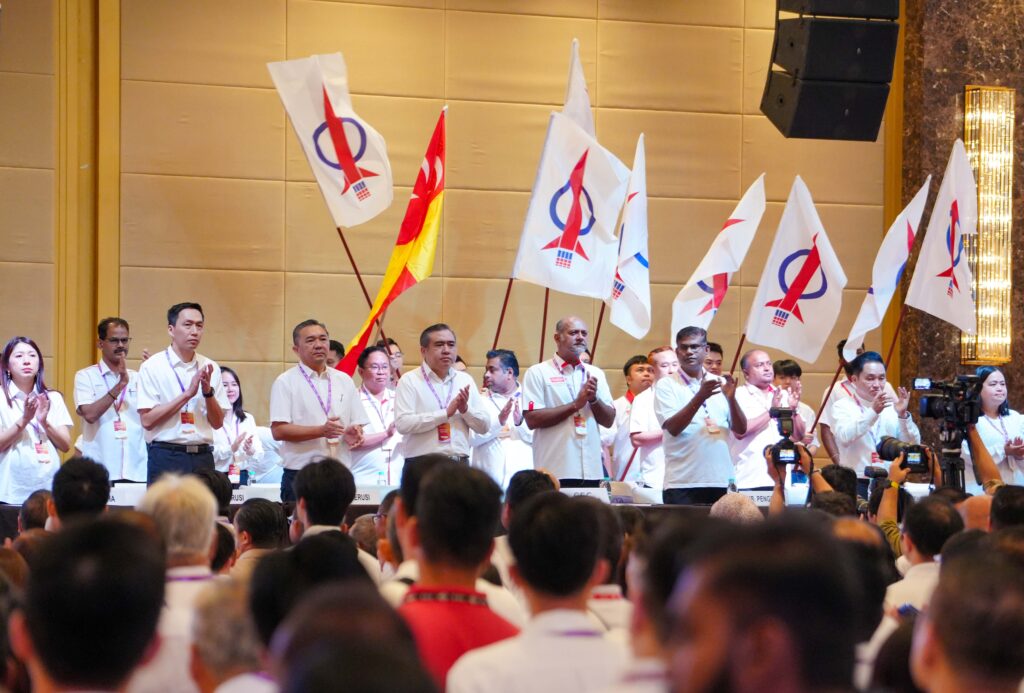
DAP's Decision to Stay or Leave Will Still Impact Malaysian Government
Translated from Malay, summarized and contextualized by DistantNews.
At a glance
News
Named sources
Context piece
- DAP's decision to remain in or leave the Malaysian unity government after August 16 will impact the coalition's stability.
- Remaining in government may erode trust among non-partisan supporters, while leaving would remove five ministers and seven deputy ministers, complicating policy and administration.
- Analysts warn that a major party's exit could create perceptions of fragility, uncertainty for investors and civil servants, and open avenues for opposition narratives.
The Malaysian unity government faces a critical juncture as the Democratic Action Party (DAP) prepares to decide its future within the coalition. The party's national conference on August 16 will determine whether DAP remains in the Cabinet or withdraws, a decision expected to significantly affect the stability of the Perikatan Harapan (PH) coalition.
Should DAP choose to stay, it risks a deficit of trust from its non-partisan supporters. Conversely, a departure would mean the resignation of five ministers and seven deputy ministers, inevitably impacting the government's administrative capacity and policy planning. Ilham Centre Executive Director Hisommudin Bakar noted that a major party's exit from the Cabinet could foster perceptions of a fragile government, leading to uncertainty among investors, civil servants, and the public. This scenario also provides an opening for the opposition to amplify narratives of internal discord.
"The biggest challenge is not the number of seats, but the stability of the administration and political confidence," Hisommudin stated. He added that while the government might mathematically endure, losing a key partner would complicate decision-making, policy coordination, and inter-party relations leading up to the 16th General Election (PRU16).
The biggest challenge is not the number of seats, but the stability of the administration and political confidence.
DAP Secretary-General Anthony Loke Siew Fook announced that the decision rests with the delegates, not the Central Executive Committee (CEC). Loke also recently resigned as Negeri Sembilan DAP Chairman after 22 years, following the party's defeat in the Chennah state seat. Meanwhile, DAP Perak Vice Chairman Dr. Abdul Aziz Bari urged the party to remain, emphasizing the need to continue PH's agenda and policies until PRU16. He highlighted DAP's consistent commitment to PH's democratic, transparent, and people-centric principles since the coalition's inception.
DAP National Vice Chairman Syahredzan Johan suggested the motion to reconsider the party's position stems from the political pressures faced after recent election cycles. He acknowledged that the party is navigating a challenging political landscape, including recent electoral outcomes that have created significant pressure.
DAP is committed to PH's policies from the beginning. Even in Pakatan Rakyat (PR) before, we championed open democratic politics and prioritized the people.
DistantNews Editorial
Originally published by Utusan Malaysia in Malay. Translated, summarized, and contextualized by our editorial team with added local perspective. Read our editorial standards.
More Stories



From Our Blog

What Gets Lost (and Found) When News Is Translated

The Critical Role of Diaspora Media in Global News

What Travellers Should Know About Countries with Restricted Press

A Digital Nomad's Guide to Following Local News

How the Same Story Looks Different in Different Countries
