

Date Workers Toil Through Rising Heat in Sindh
Translated from English, summarized and contextualized by DistantNews.
At a glance
News
Named sources
Context piece
- Date workers in Pakistan's Sindh province face increasingly unbearable heat during the harvest season, with temperatures regularly reaching the mid-40s Celsius.
- Laborers report suffering from heatstroke, fainting, and fever due to the harsh conditions, impacting their health and ability to work.
- Rising temperatures, linked to climate change, are exacerbating the difficulties of date farming, a crucial industry for Pakistan's exports and local employment.
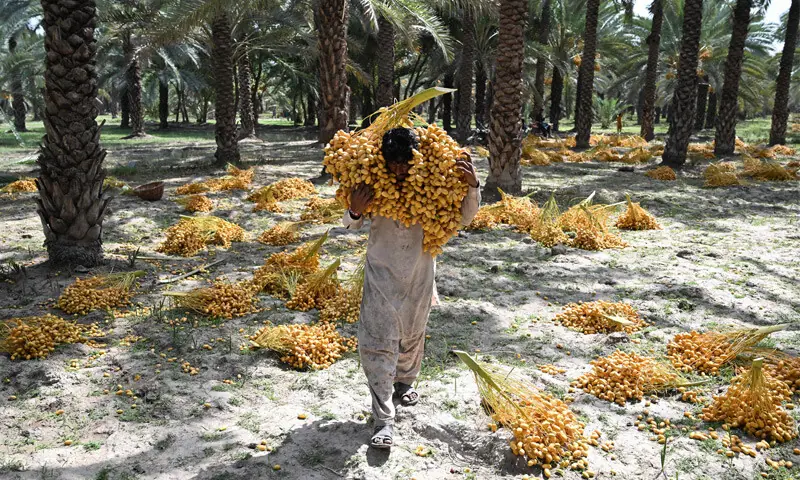
In the Sindh province of Pakistan, the annual date harvest, a vital industry for the region, is becoming an increasingly perilous undertaking. Muhammad Idrees, a date laborer, describes the heat during the July harvest as "unbearable," a stark contrast to previous years. Workers begin their demanding routine before sunrise, harvesting and boiling dates under a relentless sun, but the rising temperatures, often hitting the mid-40s Celsius, make the work extremely difficult.
"The heat is much harsher and the days are extremely hot. We fall ill because of it," Idrees told AFP, recounting instances of heatstroke, fainting, and fever among his colleagues. Despite these health risks, laborers like Idrees earn approximately Rs1,200, or about $4, per day for their physically demanding work, which involves harvesting, boiling, and drying the fruit.
It used to be less intense. The heat is much harsher and the days are extremely hot. We fall ill because of it.
Pakistan, a major global date producer, earns over $120 million annually from exports. However, the industry faces significant challenges beyond the immediate heat. Shahnawaz Phulpoto, a date farmer, notes that shifting weather patterns have led to heavy monsoon rains that have hampered crops and caused financial losses. Yet, the immediate and most pressing concern remains the escalating heat.
"The temperature rises every year," Phulpoto stated, emphasizing the visible effects of climate change. Pakistan is highly vulnerable to climate change, experiencing frequent heatwaves, erratic monsoons, and devastating floods, despite contributing minimally to global greenhouse gas emissions. The rising temperatures directly threaten the livelihoods of thousands of farmers and seasonal laborers dependent on the date harvest.
The temperature rises every year. We are seeing the effects of climate change every year.
DistantNews Editorial
Originally published by Dawn in English. Translated, summarized, and contextualized by our editorial team with added local perspective. Read our editorial standards.
More Stories

From Our Blog

What Gets Lost (and Found) When News Is Translated

The Critical Role of Diaspora Media in Global News

What Travellers Should Know About Countries with Restricted Press

A Digital Nomad's Guide to Following Local News

How the Same Story Looks Different in Different Countries
