


Deepfake exploitation surges in Korea as US, EU tighten platform rules
Translated from Korean, summarized and contextualized by DistantNews.
At a glance
News
Sources not specified
Ongoing story
- South Korea faces a surge in deepfake sexual exploitation crimes, with cases increasing tenfold in two years, while the US and EU implement stricter regulations on platforms.
- The US mandates platforms to delete non-consensual sexual content within 48 hours, imposing fines up to $53,088 per violation, while the EU's AI Act prohibits AI systems that generate such content, with potential fines up to 7% of global revenue.
- In contrast, South Korea relies on self-regulation, lacking clear legal provisions for platforms to proactively block deepfake tools, leading to calls for legislative reform to establish clearer deletion deadlines and preventive measures.
Deepfake technology is increasingly being weaponized for sexual exploitation in South Korea, with reported cases skyrocketing tenfold between 2023 and 2025. This alarming trend has prompted calls for stronger regulatory action, drawing comparisons to the more stringent measures adopted by the United States and the European Union. While these international bodies are placing direct responsibility on platforms for content moderation, South Korea's current approach relies heavily on self-regulation by the platforms themselves.
The U.S. has enacted the 'TAKE IT DOWN Act,' which mandates platforms to remove non-consensual sexual content, including duplicates, within 48 hours of a deletion request. Failure to comply can result in civil penalties of up to $53,088 per violation, enforced by the U.S. Federal Trade Commission. Similarly, the European Parliament recently passed amendments to its AI Act, effectively banning AI systems designed to create or manipulate sexual imagery without consent. Companies violating these rules face administrative fines of up to 35 million euros or 7% of their previous year's total revenue, whichever is greater.
Illegal deepfakes cause irreparable harm once created and disseminated. Complementary legislation is needed to prevent the distribution of creation tools and, like the U.S., set specific deadlines for removal.
South Korea's legal framework, however, lacks specific provisions within laws like the Act on the Punishment of Sexual Crimes, the Telecommunications Business Act, or the Information and Communication Network Act that clearly obligate platforms to proactively block tools capable of creating deepfake content. The current system primarily relies on post-publication removal of deepfake material and government-led real-time blocking of deepfake websites, a reactive approach that struggles to keep pace with the proliferation of such content.
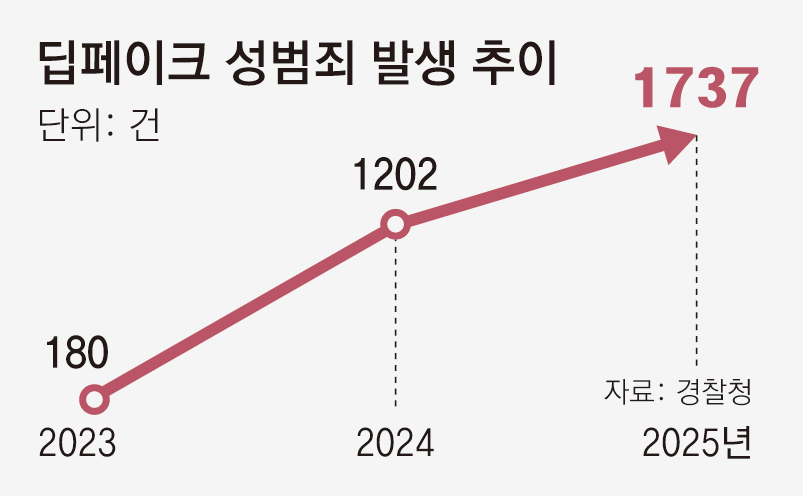
This regulatory gap is highlighted by the significant increase in deepfake sexual crimes, which rose from 180 cases in 2023 to 1,737 in 2025, according to police data. Furthermore, South Korea's 'without delay' stipulation for content removal is less specific than the U.S.'s 48-hour deadline. A bill proposing a 24-hour removal window was introduced in December but remains pending in the National Assembly. Experts like Lee Sung-yeop from Korea University advocate for legislative improvements, emphasizing the need for specific deletion deadlines and preventative measures to curb the creation and distribution of illegal deepfake content, arguing that once created and disseminated, such material causes irreparable harm.
Current laws alone have limitations in preventing the creation and distribution of illegal deepfake content through AI services. We are considering establishing systems to prevent such negative functions from the service provision stage.
DistantNews Editorial
Originally published by Dong-A Ilbo in Korean. Translated, summarized, and contextualized by our editorial team with added local perspective. Read our editorial standards.
More Stories


From Our Blog

What Gets Lost (and Found) When News Is Translated

The Critical Role of Diaspora Media in Global News

What Travellers Should Know About Countries with Restricted Press

A Digital Nomad's Guide to Following Local News

How the Same Story Looks Different in Different Countries
