


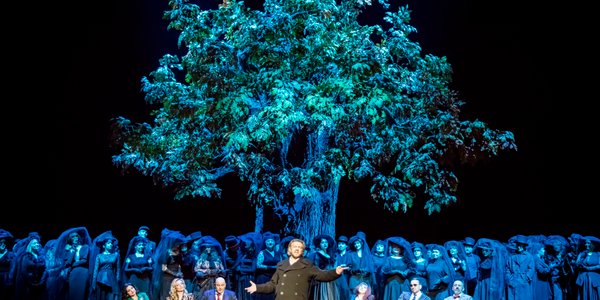
Director Departs with Falstaff at the National Opera
Translated from Polish, summarized and contextualized by DistantNews.
TLDR
- Director Marek Weiss is departing the National Opera, with his production of 'Falstaff' serving as his farewell.
- Weiss, known for revolutionizing Polish opera in the 1980s, collaborated again with scenographer Wiesław Olko on 'Falstaff,' recreating elements from their past successful productions.
- The production reimagines Falstaff as a human figure, portrayed by baritone Sergio Vitale, and sets the story in a contemporary London nightclub, with some elements hinting at Polish organized crime.
The National Opera is bidding farewell to director Marek Weiss, a figure who significantly shaped the landscape of Polish opera. His departure, marked by the current production of Verdi's 'Falstaff,' signifies the end of an era for an artist known for his bold reinterpretations and influential stagecraft.
Let's assume that 'Falstaff' is Marek Weiss's real farewell.
Weiss, alongside his long-time collaborator Wiesław Olko, has a history of groundbreaking productions that challenged conventions in Polish theater. Their work together in the 1980s is remembered as a revolutionary period for Polish opera. For 'Falstaff,' they have revisited this creative partnership, infusing the production with echoes of their past successes, such as the visually striking 'Traviata' from 1987, which also featured Olko's detailed scenography.
He certainly won't follow in the footsteps of Plácido Domingo, who is still clinging tightly to the microphone.
This production of 'Falstaff' offers a contemporary take on the Shakespearean character. Baritone Sergio Vitale portrays Falstaff not as a caricature, but as a complex, human figure. The setting shifts to a modern London nightclub, a choice that allows for a re-examination of the opera's themes within a new context. However, some elements, like the appearance of guards with baseball bats and a Fenton reminiscent of 1990s Polish mafia figures, introduce a distinctly local, perhaps even jarring, flavor that may not resonate universally.
He realized 'Falstaff' with his former scenographic partner Wiesław Olko, with whom he created such extraordinary stagings as 'Gates of Paradise' with a white horse in the audience of the Teatr Wielki or 'Macbeth,' in which Shakespearean witches flew onto the stage from a height of several floors.
From a Polish perspective, Weiss's departure is noteworthy. Unlike some artists who prolong their careers indefinitely, Weiss seems committed to a definitive farewell. His influence on Polish opera is undeniable, paving the way for subsequent generations of directors. The 'Falstaff' production, while perhaps uneven in its contemporary references, showcases Weiss's enduring directorial style and his willingness to engage with classic works in innovative ways, making his exit a significant moment for the National Opera and the broader Polish cultural scene.
In 'Falstaff,' there is the atmosphere of 'La Traviata' from 1987, because for both these productions Wiesław Olko created sophisticated interiors with many details.
DistantNews Editorial
Originally published by Rzeczpospolita in Polish. Translated, summarized, and contextualized by our editorial team with added local perspective. Read our editorial standards.
More Stories



From Our Blog

What Gets Lost (and Found) When News Is Translated

The Critical Role of Diaspora Media in Global News

What Travellers Should Know About Countries with Restricted Press

A Digital Nomad's Guide to Following Local News

How the Same Story Looks Different in Different Countries
