


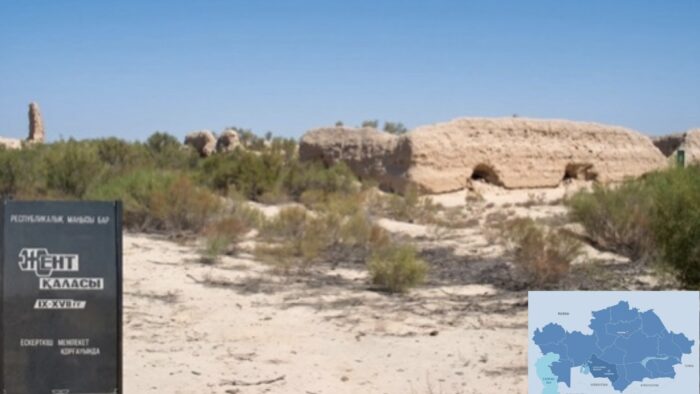
Djend: Silk Road City That Minted Coins for Golden Horde
Summarized and contextualized by DistantNews.
At a glance
In-depth
Named sources
Context piece
- Djend, a medieval city in Kazakhstan's Kyzylorda Region, was a significant Silk Road hub for trade, politics, and Islamic culture.
- The city played a key role in the Golden Horde, minting coins and serving as an administrative center.
- Djend declined due to Amir Temir's campaigns and falling water levels in the Syr Darya River, eventually being abandoned by the 16th century.
The ruins of Djend, located in Kazakhstan's Kyzylorda Region, offer a window into a vibrant medieval city that was a crucial center of trade, politics, and Islamic culture along the Silk Road. Historian Darkhan Ilyasov notes that Djend, situated near the lower Syr Darya River, was first mentioned in the 10th century and became a major commercial and strategic hub due to its location at the crossroads of caravan routes.
Initially, Djend was a large fortress and trading center within the Oghuz Khaganate. Its history is closely connected with the rise of the Seljuk Empire. Seljuk Beg, founder of the Seljuk dynasty, is believed to have embraced Islam in Djend, making the religion a cornerstone of his future state. Historical accounts also suggest that Suleiman Shah, one of the founders of the Seljuk state, may have been buried there.
Djend's history is intertwined with the Oghuz Khaganate and the rise of the Seljuk Empire. It is believed that Seljuk Beg, the dynasty's founder, embraced Islam in Djend, making it a foundational element of his future state. Historical accounts also suggest that Suleiman Shah, a founder of the Seljuk state, might be buried there.
Unlike many other cities, Djend largely escaped destruction during the Mongol invasions. Jochi Khan, Genghis Khan's eldest son, brought the city under Mongol rule peacefully and used it as a headquarters. During the 13th and 14th centuries, Djend flourished as a major administrative and economic center of the Golden Horde, even operating a mint that produced coins bearing the names of its rulers, signifying its financial and strategic importance.
This demonstrates the city’s financial and strategic importance within the state.
Medieval travelers described Djend as a prosperous city with fertile lands and bustling markets, attracting merchants from across Asia and Europe. Archaeological findings reveal a sophisticated urban culture with advanced pottery, metallurgy, jewelry making, and bone carving. Djend was also a prominent center for Islamic scholarship, boasting mosques, madrasas, and libraries, with many scholars adding "al-Jandi" to their names. The city's decline began in the late 14th and early 15th centuries due to the campaigns of Amir Temir and diminishing water levels in the Syr Darya, leading to its eventual abandonment by the 16th century.
The city was home to magnificent mosques, madrasas and large libraries. Scholars originating from Djend often added the nisba ‘al-Jandi’ to their names.
DistantNews Editorial
Originally published by The Astana Times. Summarized and contextualized by our editorial team with added local perspective. Read our editorial standards.
More Stories



From Our Blog

What Gets Lost (and Found) When News Is Translated

The Critical Role of Diaspora Media in Global News

What Travellers Should Know About Countries with Restricted Press

A Digital Nomad's Guide to Following Local News

How the Same Story Looks Different in Different Countries
