

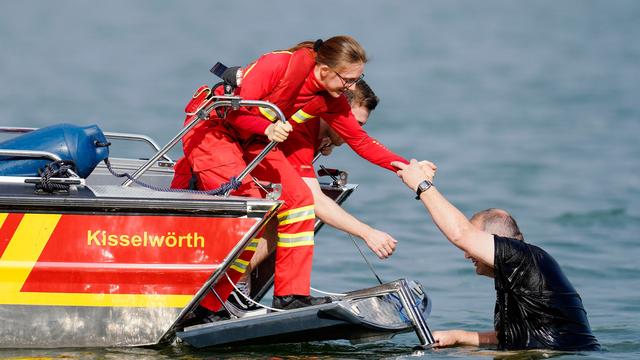

DLRG: Most drowning deaths preventable with more education
Translated from German, summarized and contextualized by DistantNews.
At a glance
News
Named sources
Context piece
- The German Life Saving Association (DLRG) estimates that most of the 99 drowning deaths in June were preventable.
- DLRG President Ute Vogt called for a broad public awareness campaign, noting that Germany lacks national drowning prevention goals unlike countries like Sweden, the UK, and the Netherlands.
- The association advocates for improved swimming education, better-equipped swimming facilities, and more qualified instructors in schools and public pools.
The German Life Saving Association (DLRG) is urging for increased public education on water safety, estimating that the majority of the 99 drowning deaths recorded in June alone were preventable. DLRG President Ute Vogt emphasized that while anyone can be at risk, these accidents could be avoided with greater awareness. She called for a "broad public awareness campaign" to address the issue, noting that the responsibility for public education currently falls on the DLRG and other water rescue organizations. The association highlighted the need for better information about the dangers of various bodies of water. Vogt suggested that municipalities could collaborate with water rescue organizations to expand supervised swimming areas and install safety equipment at unsupervised locations. She also pointed to potential within schools, where rescuers visit around 2,000 kindergartens and primary schools annually, stressing the importance of discussing water dangers and safe behavior with older students before the summer holidays. The DLRG president urged the federal government to contribute through national information campaigns, contrasting Germany's approach with countries like Sweden, Great Britain, and the Netherlands, which have established state-level drowning reduction targets. "Unfortunately, something like this has not yet been an issue at the state level in Germany," Vogt stated. The DLRG identifies weak and non-swimmers as particularly vulnerable. To improve their training, the association calls for the renovation or construction of swimming pools, increased staffing in existing pools, and more qualified swimming instructors for school-based lessons.
To do something about it, a broad public awareness campaign is necessary.
DistantNews Editorial
Originally published by Die Zeit in German. Translated, summarized, and contextualized by our editorial team with added local perspective. Read our editorial standards.
More Stories



From Our Blog

What Gets Lost (and Found) When News Is Translated

How the Same Story Looks Different in Different Countries

The Critical Role of Diaspora Media in Global News

What Travellers Should Know About Countries with Restricted Press

A Digital Nomad's Guide to Following Local News
