


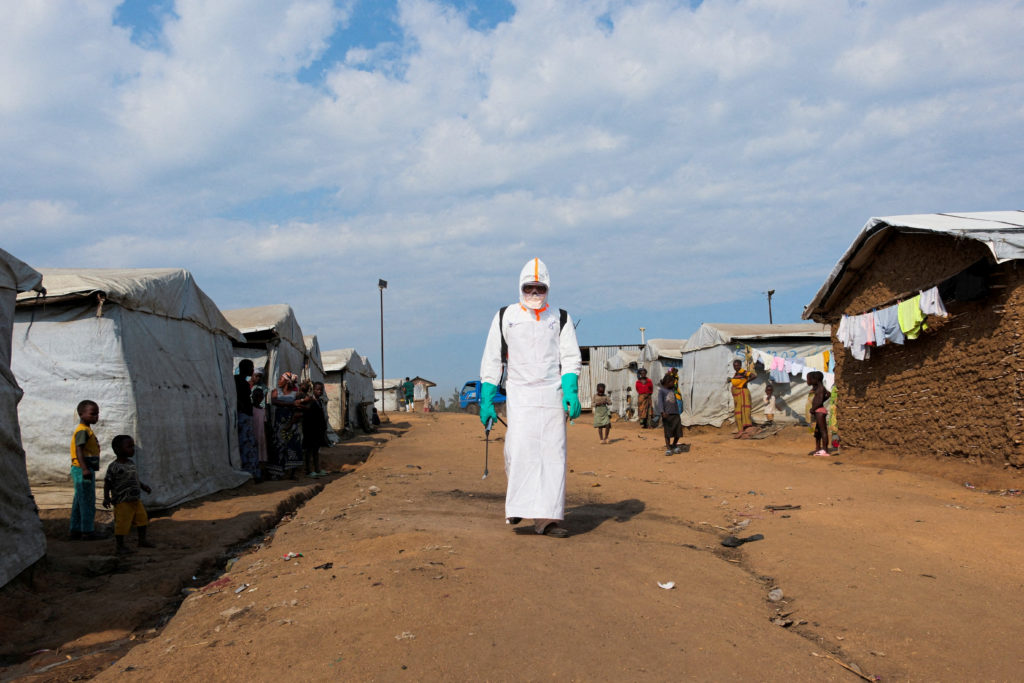
Ebola outbreak in Congo and Uganda kills over 1,000 as officials race to contain virus
Translated from English, summarized and contextualized by DistantNews.
At a glance
News
From a news agency
Ongoing story
- The Ebola outbreak in eastern Congo and Uganda has claimed over 1,000 lives, with more than 2,500 confirmed cases.
- Health officials are racing to contain the virus, which is spreading despite some signs of slowing, as contact tracing lags.
- The World Health Organization assesses the risk as "very high" within Congo and "high" in neighboring countries, though the global risk remains low.
The deadliest Ebola outbreak in history continues its relentless spread across eastern Congo and neighboring Uganda, claiming more than 1,000 lives amidst a desperate race to contain the virus. As of Wednesday, Congo's public health institute reported 2,536 confirmed cases and 1,033 deaths, with hundreds more patients in isolation or hospitalized. This outbreak, declared on May 15, is particularly concerning because the responsible Bundibugyo virus lacks an approved vaccine or treatment.
The fastest-growing Ebola outbreak in history has killed more than 1,000 people in eastern Congo as health officials race to contain a virus with no approved vaccine or treatment.
While Congolese officials suggest the rapid surge in cases may be slowing, they caution that the outbreak has not yet peaked. Transmission remains persistent, with fluctuations likely due to reporting delays and ongoing data consolidation. A critical challenge is the lagging contact tracing efforts; only about 77% of known contacts are being monitored, falling short of the 95% target deemed necessary to halt transmission. This makes it difficult for responders to grasp the full extent of the outbreak and its potential to worsen.
While Congolese officials say the sharp rise in cases appears to be slowing, they caution the outbreak has not yet peaked.
Computer modeling by U.S. Centers for Disease Control and Prevention researchers paints a grim picture, suggesting a worst-case scenario could rival the devastating West Africa epidemic of 2014-2016, which caused over 11,000 deaths. The origin of the current outbreak remains a mystery, with the World Health Organization noting that most cases stem from unknown transmission chains.
Contact tracing continues to lag, with only around 77% of known contacts monitored nationwide, well below the 95% target health officials say is needed to interrupt transmission.
Despite the high case numbers, the World Health Organization maintains that the global risk of spread is low. Ebola transmits through direct contact with bodily fluids, making it less contagious than airborne respiratory viruses. While additional imported cases are expected, they have so far been quickly identified and contained, preventing sustained transmission beyond the affected regions. The WHO considers the risk "very high" within Congo and "high" in Uganda and adjacent countries due to cross-border movement and ongoing transmission.
The WHO continues to assess the risk from the outbreak as "very high" inside Congo and "high" in Uganda and neighboring countries, citing cross-border spread, frequent population movement and ongoing transmission in eastern Congo.
DistantNews Editorial
Originally published by PBS NewsHour in English. Translated, summarized, and contextualized by our editorial team with added local perspective. Read our editorial standards.
More Stories


From Our Blog

How the Same Story Looks Different in Different Countries

What Gets Lost (and Found) When News Is Translated

The Critical Role of Diaspora Media in Global News

What Travellers Should Know About Countries with Restricted Press

A Digital Nomad's Guide to Following Local News
