


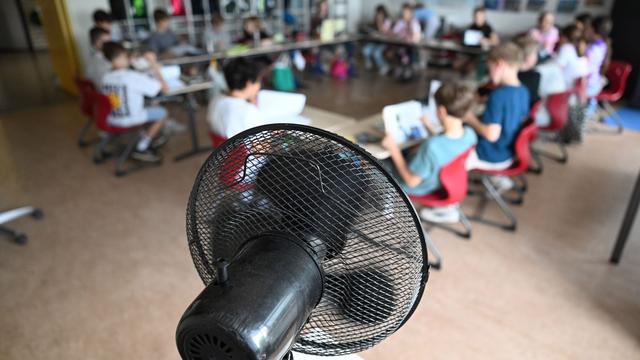
Education: Heat alarm at the end of the holidays: What awaits students
Translated from German, summarized and contextualized by DistantNews.
At a glance
News
From a news agency
Context piece
- Germany is bracing for a heatwave with temperatures approaching 40 degrees Celsius as summer holidays end.
- Experts warn that high temperatures in classrooms can significantly impair students' learning abilities, attention, and concentration.
- Rules for "heat-free" days vary by German federal state, with many schools having discretion over when to grant them based on classroom temperatures and other factors.
As summer holidays draw to a close in many German states, the country is facing a significant heatwave, with temperatures expected to soar towards 40 degrees Celsius. This intense heat poses a considerable challenge for students returning to classrooms, potentially making focused learning a difficult task.
The body expends energy on cooling, which diverts resources from attention, working memory, and reaction speed.
Pia Rangnow of the German Alliance for Climate Change and Health highlights the physiological impact of heat on children. She explains that the body expends energy on cooling, which diverts resources from attention, working memory, and reaction speed. Children experiencing heat stress may appear exhausted and unfocused, suffering from accompanying symptoms like headaches, nausea, dizziness, or lethargy. Rangnow emphasizes that the cumulative effect of learning in overheated rooms year after year can lead to significant learning deficits, potentially amounting to several lost weeks of education over a student's school career. Children are generally less equipped than adults to regulate their body temperature, absorbing heat faster and sweating less efficiently.
Children experiencing heat stress appear exhausted and unfocused, with accompanying headaches, nausea, dizziness, or lethargy.
The decision to grant "heat-free" days, or Hitzefrei, varies considerably across Germany's 16 federal states. In many states, school principals have considerable leeway in making this decision. For instance, Baden-Württemberg has no statewide regulations or temperature thresholds, though it recommends allowing heat-free days if the outdoor temperature reaches at least 25 degrees Celsius in the shade by 11 a.m., and no earlier than after the fourth class period. In contrast, North Rhine-Westphalia uses a classroom temperature of over 27 degrees Celsius as a guideline, while Bremen and Lower Saxony have no fixed temperature for granting heat-free days.
Students who learn in overheated rooms year after year fall behind. Over the entire school career, this can add up to several lost weeks of learning.
Some states consider multiple factors beyond just temperature. Rhineland-Palatinate, for example, takes into account humidity, solar radiation, air movement, the duration of the heat exposure, and the building's structural characteristics. Brandenburg has a specific rule: if the outdoor temperature reaches 25 degrees Celsius at 10 a.m. and shows no sign of cooling, classes will end by noon for primary school students and those in grades five to ten, excluding upper secondary students. The introduction of a legal right to all-day care for primary school children, gradually implemented from August 1st, will also need to accommodate these heat-related challenges in the coming years.
They absorb heat faster, sweat less efficiently, and generate more metabolic heat during activity.
DistantNews Editorial
Originally published by Die Zeit in German. Translated, summarized, and contextualized by our editorial team with added local perspective. Read our editorial standards.
More Stories

From Our Blog

What Gets Lost (and Found) When News Is Translated

How the Same Story Looks Different in Different Countries

The Critical Role of Diaspora Media in Global News

What Travellers Should Know About Countries with Restricted Press

A Digital Nomad's Guide to Following Local News
