


Education in the Dominican Republic and its learning outcomes
Translated from Spanish, summarized and contextualized by DistantNews.
At a glance
News
Documents & data
Context piece
- The Dominican Republic has increased student enrollment and completion rates across educational cycles, but learning outcomes have not improved proportionally.
- In mathematics, only 2% of primary students reach the minimum competency level, a figure unchanged since 2015, indicating a critical structural stagnation.
- While reading proficiency has doubled since 2015, 84% of primary students still do not meet minimum standards, highlighting academic quality as the nation's most critical challenge.
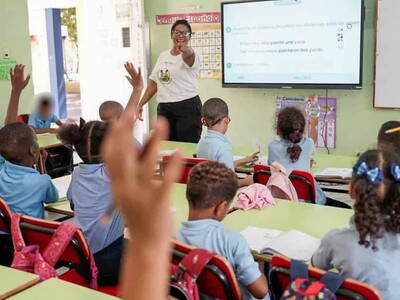
The Dominican Republic celebrates increased access to education, with more students completing primary and secondary levels than ever before. However, this expansion in coverage and retention has not translated into a corresponding improvement in actual learning. A stark reality revealed by the 2026 World Education Monitoring Report (GEM 2026) shows that a mere 2% of students achieve the minimum competency level in mathematics upon finishing primary school.
This alarming statistic means that 98 out of 100 Dominican students conclude their primary education without mastering fundamental mathematical skills. Worryingly, this percentage has remained stagnant for nearly a decade, with the 2015 report also citing the same 2% figure. The GEM report labels this situation a "critical structural stagnation," contrasting sharply with the positive trends in educational access and completion.
In contrast, reading proficiency has seen a more positive, albeit low-base, evolution. The percentage of students meeting minimum reading competency at the end of primary school doubled from 8% in 2015 to 16% in 2024. Despite this improvement, the report cautions that this advance starts from a very low point, leaving approximately 84% of students still below the minimum standard upon primary completion.
Further analysis incorporating PISA 2022 results for lower secondary education reveals persistent difficulties. Only 25% of students demonstrate minimum competency in reading, and a dismal 8% in mathematics. The GEM report concludes that academic quality remains "the most critical national challenge" for the Dominican Republic as it strives to meet Sustainable Development Goal 4 by 2030.
DistantNews Editorial
Originally published by Diario Libre in Spanish. Translated, summarized, and contextualized by our editorial team with added local perspective. Read our editorial standards.
More Stories

From Our Blog

What Gets Lost (and Found) When News Is Translated

The Critical Role of Diaspora Media in Global News

What Travellers Should Know About Countries with Restricted Press

A Digital Nomad's Guide to Following Local News

How the Same Story Looks Different in Different Countries
