


Elderly income up 79% in 10 years... 'Children's pocket money' decreased, public pensions increased
Translated from Korean, summarized and contextualized by DistantNews.
At a glance
News
Documents & data
Context piece
- The annual income of South Koreans aged 66 and over increased by 79% over the past decade, rising from 7.75 million won in 2013 to 13.88 million won in 2023.
- During the same period, the proportion of income derived from public pensions (National Pension, Basic Pension) rose from 16.5% to 28.2%, while income from private transfers like 'pocket money' from children decreased from 20.9% to 12.1%.
- The number of seniors receiving both the National Pension and Basic Pension also grew significantly, indicating a shift towards greater reliance on public pension systems.
The financial landscape for South Koreans aged 66 and older has significantly improved over the last decade, with their average annual income soaring by 79%. This increase, from 7.75 million won (approximately $5,800 USD) in 2013 to 13.88 million won ($10,400 USD) in 2023, reflects a substantial rise in the economic well-being of the elderly population.
A key driver of this change is the evolving structure of their income sources. The reliance on public pension systems, including the National Pension and Basic Pension, has markedly increased. Income from these sources now constitutes 28.2% of total income, up from 16.5% a decade ago. This contrasts sharply with a decline in private transfer income, such as financial support from children, which has fallen from 20.9% to 12.1% of their total earnings.
This shift is further evidenced by the changing patterns of pension receipt. The proportion of seniors receiving both the National Pension and the Basic Pension has nearly doubled, rising from 12.8% in 2013 to 23.5% in 2023. Concurrently, the share of individuals receiving only the National Pension has increased, while those relying solely on the Basic Pension has decreased.
In 2023, the average annual income for those receiving only the National Pension was 26.48 million won, more than three times that of individuals receiving only the Basic Pension (8.41 million won). This data, compiled by the National Pension Research Institute, highlights a growing stability and financial independence among the elderly, largely attributed to the expansion and increased uptake of public pension schemes.
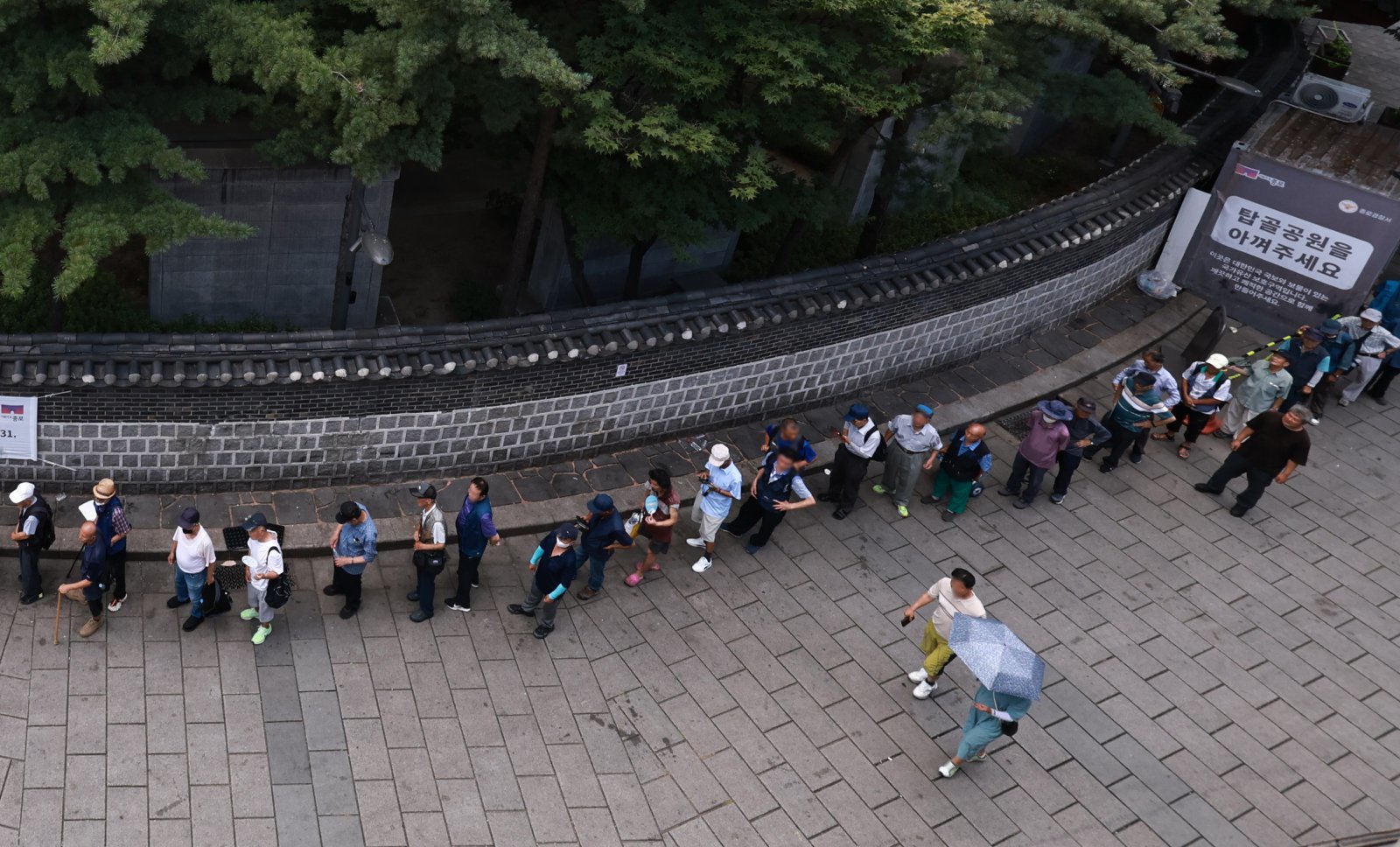
Elderly people are lining up for free meal distribution at Tapgol Park in Jongno-gu, Seoul.
DistantNews Editorial
Originally published by Dong-A Ilbo in Korean. Translated, summarized, and contextualized by our editorial team with added local perspective. Read our editorial standards.
More Stories

From Our Blog

What Gets Lost (and Found) When News Is Translated

The Critical Role of Diaspora Media in Global News

What Travellers Should Know About Countries with Restricted Press

A Digital Nomad's Guide to Following Local News

How the Same Story Looks Different in Different Countries
