


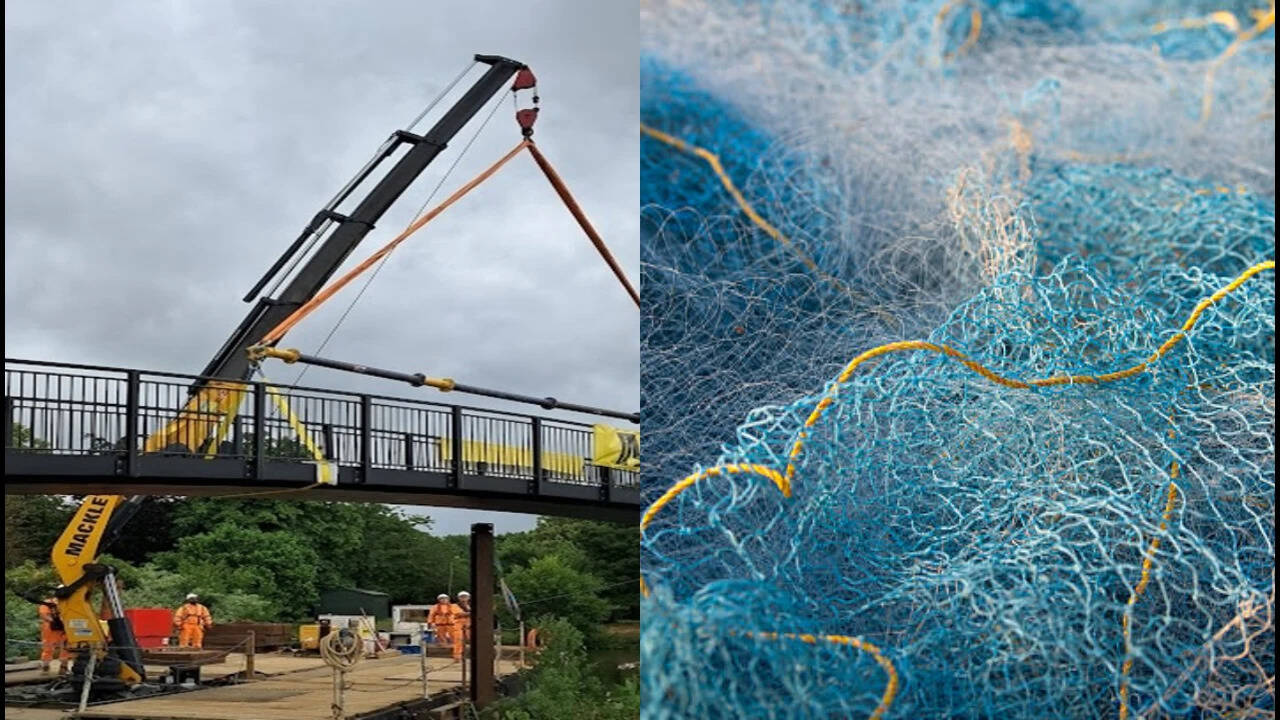
England builds 16-meter footbridge from recycled fishing nets
Translated from English and summarized by DistantNews. Read the original for the full story.
At a glance
News
From a news agency
Outcome reported
- England has constructed a 16-meter footbridge in Kent using recycled fishing nets, significantly reducing its carbon footprint.
- The bridge utilizes fiber-reinforced polymer (FRP) made from the nets, offering a lightweight yet strong alternative to traditional materials.
- The construction employed a modular block system, similar to Lego, reducing the need for concrete and simplifying assembly in a challenging location.
In a novel approach to sustainable infrastructure, England has unveiled a 16-meter footbridge in Kent constructed primarily from recycled fishing nets. The innovative structure, located at Twyford Marina in Yalding, aims to minimize environmental impact through its material choice and construction method.
The bridge deck and main structure are made from fiber-reinforced polymer (FRP), a material derived from discarded fishing nets. This recycled material provides a blend of strength and light weight, making the 3.5-ton bridge considerably lighter than conventional structures of similar size. This weight reduction also allowed for smaller support foundations, further reducing the material needed.
Beyond the recycled materials, the construction process itself was designed for efficiency and reduced environmental impact. The project utilized modular blocks, which fit together like a "Lego system" with minimal mortar. This method, as reported by GOV.UK, requires less reinforced concrete, simplifying construction and potentially lowering the project's carbon footprint.
The bridge's journey to its final location was also noteworthy. Built in the Netherlands, it was shipped to Nottinghamshire for handrails, then transported by road to Yalding, and finally floated up the River Medway by barge before being lifted into place. The Environment Agency anticipates that the FRP structure will require less maintenance than traditional bridges, showcasing a practical application of circular economy principles in infrastructure development.
About this summary
Originally published by Times of India in English. Translated, summarized, and contextualized automatically by DistantNews, with a note on how the source frames the story. Not individually reviewed before publishing. How this works.
More Stories


From Our Blog

What Press Freedom Means for the News You Read

What Gets Lost (and Found) When News Is Translated

The Critical Role of Diaspora Media in Global News

What Travellers Should Know About Countries with Restricted Press

A Digital Nomad's Guide to Following Local News
