


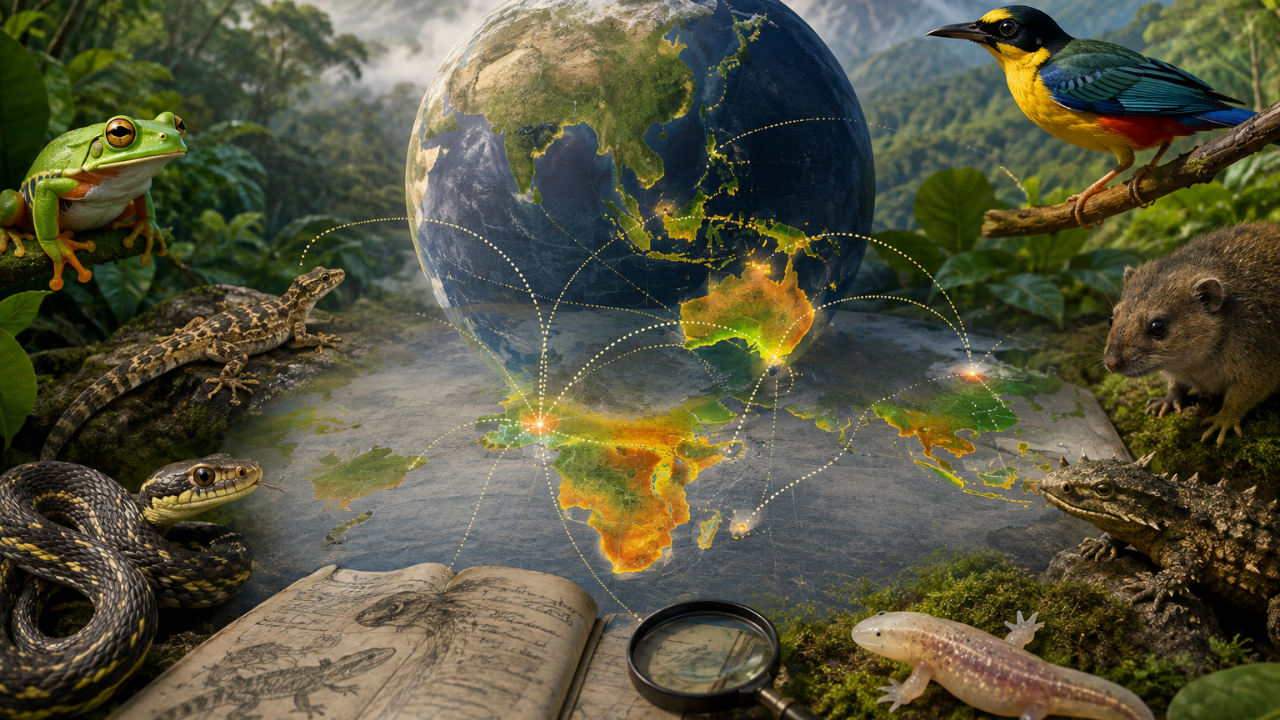
100 years of discovery reshaped global biodiversity maps, study finds
Translated from English and summarized by DistantNews. Read the original for the full story.
At a glance
News
Sources not specified
Outcome reported
- A century of scientific discoveries has altered maps of global biodiversity hotspots, particularly for reptiles and amphibians.
- Australia and Southeast Asia have become more prominent biodiversity centers as new species were documented.
- The study, published in Ecology Letters, analyzed terrestrial vertebrate discoveries from 1920 to 2020.
Over the past century, scientific discoveries have significantly reshaped our understanding of global biodiversity, particularly altering perceptions of where the world's most diverse terrestrial vertebrate species are concentrated. A new study published in Ecology Letters examined how a century of taxonomic discoveries, from 1920 to 2020, influenced estimates of biodiversity hotspots.
The research found that while diversity patterns for birds remained relatively stable, and environmental drivers for birds and mammals were consistent, reptiles and amphibians underwent substantial reconfiguration. The study revealed that 20.3% of reptile diversity centers and 31.7% of amphibian diversity centers shifted to different regions over the 100-year period. This shift highlights how incomplete taxonomic knowledge can lead to an incomplete picture of biodiversity distribution.
Regions like Australia and Southeast Asia have emerged as more prominent biodiversity centers, especially for reptiles and amphibians, as new species within these groups were discovered and formally recognized. The study's methodology focused on range-weighted rarity, identifying areas with species that have particularly restricted distributions, rather than just areas with the highest number of species.
These findings suggest that ongoing species discovery can directly influence conservation priorities by changing which parts of the world are recognized as most critical for biodiversity. The study also noted shifts in the environmental factors associated with species richness, with precipitation emerging as a more crucial element.
About this summary
Originally published by Times of India in English. Translated, summarized, and contextualized automatically by DistantNews, with a note on how the source frames the story. Not individually reviewed before publishing. How this works.
More Stories


From Our Blog

What Press Freedom Means for the News You Read

What Gets Lost (and Found) When News Is Translated

The Critical Role of Diaspora Media in Global News

What Travellers Should Know About Countries with Restricted Press

A Digital Nomad's Guide to Following Local News
