


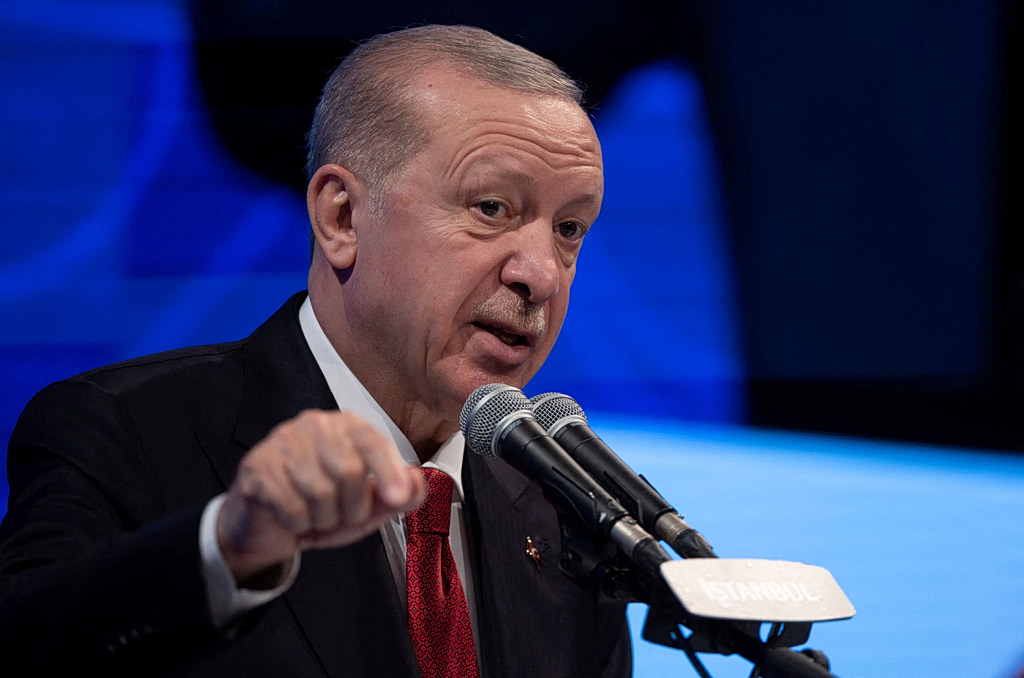
Erdoğan launches fresh attack on Israel: “The region is paying the price for its aggressive policy”
Translated from Greek and summarized by DistantNews. Read the original for the full story.
At a glance
Newswire
From a news agency
Context piece
- Turkish President Recep Tayyip Erdoğan said 74,000 people had been killed in Israeli attacks in Gaza, most of them women and children, and said the region was paying the price of Israel’s policy.
- He said discussions about peace must include Gaza and Lebanon.
- Erdoğan also described the Turkey-Saudi Arabia-Pakistan Mecca Defense Alliance as based on regional ownership and collective deterrence.
Recep Tayyip Erdoğan renewed his criticism of Israel, saying the conflicts in Gaza and Lebanon must remain central to any discussion of peace in the Middle East.
The Turkish president said 74,000 people had died in Israeli attacks in Gaza, most of them women and children. “We must not forget Gaza, where 74,000 people, most of them women and children, have lost their lives because of Israel’s attacks, as well as Lebanon, when discussing peace,” he said. “Our entire region is paying the price for this aggressive policy.”
We must not forget Gaza, where 74,000 people, most of them women and children, have lost their lives because of Israel’s attacks, as well as Lebanon, when discussing peace. Our entire region is paying the price for this aggressive policy.
Erdoğan also spoke at length about the Mecca Defense Alliance, which Turkey signed with Saudi Arabia and Pakistan. He said the agreement rested on regional ownership and collective deterrence, and would contribute to regional and global peace and stability.
He ended his speech by wishing Pakistan success as it prepares to assume the rotating presidency of the Shanghai Cooperation Organisation. Erdoğan said he hoped the group’s summit would support the shared future of the wider region and its countries.
The Mecca Defense Alliance, which is based on regional ownership and collective deterrence, will contribute significantly to regional and global peace and stability.
About this summary
Originally published by Ta Nea in Greek. Translated, summarized, and contextualized automatically by DistantNews, with a note on how the source frames the story. Not individually reviewed before publishing. How this works.
More Stories


From Our Blog

What Gets Lost (and Found) When News Is Translated

The Critical Role of Diaspora Media in Global News

What Travellers Should Know About Countries with Restricted Press

A Digital Nomad's Guide to Following Local News

How the Same Story Looks Different in Different Countries
