

EU's 'Schuman Roundabout' dubbed 'Europe's largest frying pan' amid renovation failures
Translated from Polish, summarized and contextualized by DistantNews.
At a glance
News
Sources not specified
Context piece
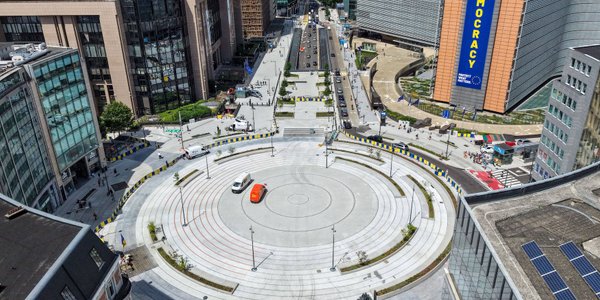
- The Schuman Roundabout in Brussels, a key EU hub, has been nicknamed "Europe's largest frying pan" due to its lack of greenery and shade.
- The recent renovation deviated from the original architectural concept, which envisioned a green, pedestrian-friendly space.
- Delays in funding and political will have hampered efforts to implement the original design, leaving the area exposed to intense summer heat.
The Schuman Roundabout in Brussels, situated at the heart of the European Union and surrounded by buildings housing the European Commission, Council of Europe, and European External Action Service, has acquired an unflattering nickname: "Europe's largest frying pan." This moniker reflects the area's stark lack of green spaces and shade, making it uncomfortably hot during summer.
Originally, the plan for the roundabout's redevelopment, presented in 2014 by then-Brussels Minister of Mobility Pascal Smet, aimed to transform the congested traffic hub into a comfortable meeting and resting place for pedestrians. The project, designed by Brut from Belgium and Cobe from Denmark under architect Francis De Wolf, envisioned a green, sheltered plaza.
However, the renovation proceeded in a manner contrary to the architects' vision. Francis De Wolf described the current state of the Schuman Roundabout as a "symbol of the failure of the city, the nation, and, to some extent, Europe." The project faced significant setbacks following the 2024 European Parliament and Belgian federal elections, which led to a prolonged period without a Belgian government. This political instability halted funding for the renovation, causing costs to exceed the initial €32 million budget.
Despite some officials claiming additional funds were available, a lack of political will prevented their release. Brussels Minister of Mobility and Public Works Elke Van den Brandt remains skeptical about fully realizing De Wolf's original design. While acknowledging the need for a roof, she expressed doubts about the viability of extensive greenery, citing underground rail and metro tunnels that restrict the planting of large, deep-rooted trees. The situation has drawn criticism from Brussels residents and officials alike, who are calling for action to address the "frying pan of Europe."
The Schuman Roundabout is now a symbol of the failure of the city, the nation, and, to some extent, Europe.
DistantNews Editorial
Originally published by Rzeczpospolita in Polish. Translated, summarized, and contextualized by our editorial team with added local perspective. Read our editorial standards.
More Stories
From Our Blog

What Gets Lost (and Found) When News Is Translated

The Critical Role of Diaspora Media in Global News

What Travellers Should Know About Countries with Restricted Press

A Digital Nomad's Guide to Following Local News

How the Same Story Looks Different in Different Countries
