


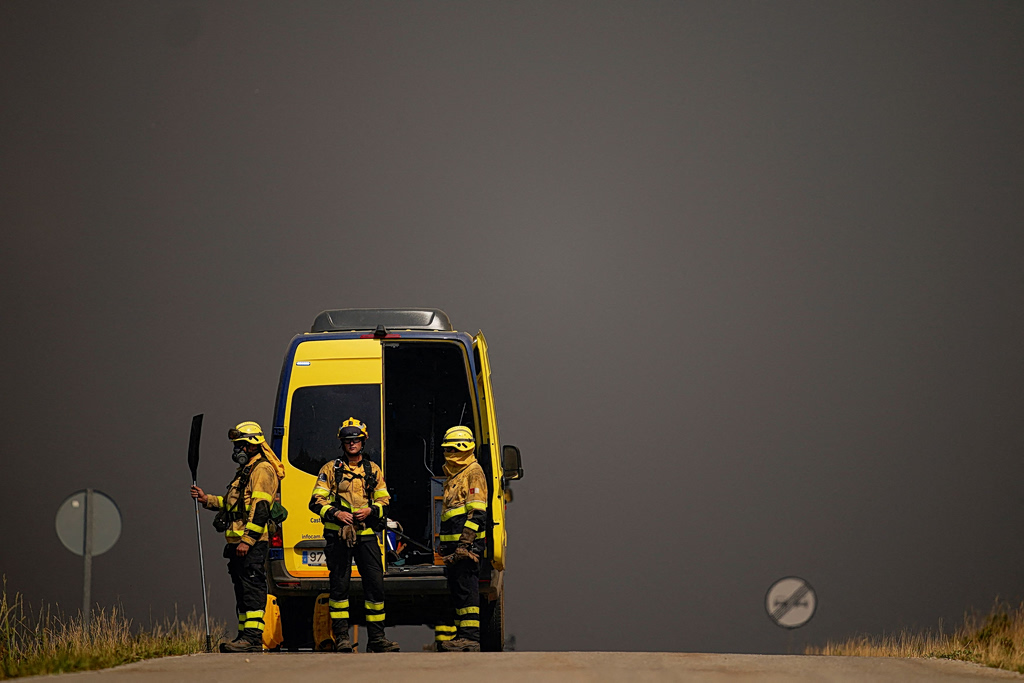
Europe's 'mega-fires' signal a new, deadly face of climate change
Translated from Greek, summarized and contextualized by DistantNews.
At a glance
News
Documents & data
Context piece
- Europe is experiencing "mega-fires" that are faster, more unpredictable, and harder to extinguish due to climate change.
- Europe is warming at twice the global average rate, leading to drier conditions even after wet winters.
- These fires now burn diverse ecosystems, create their own weather, and can spread embers miles ahead of the main front.
Europe is facing a new reality of "mega-fires" that defy traditional firefighting methods, driven by accelerating climate change. Images from Spain and France show fire fronts moving with unprecedented speed, changing direction rapidly, and igniting new blazes kilometers away. In some instances, these fires have overwhelmed even the most robust firefighting forces.
Officials in Spain have acknowledged that certain fires became "beyond the capacity to extinguish" amid extreme winds and record-high temperatures. Firefighters are not abandoning the fight, but the sheer power of these fires, fueled by environmental conditions, now surpasses available resources.
The primary driver behind this phenomenon is climate change. According to the World Meteorological Organization and the Copernicus European service, Europe is warming at approximately twice the global average rate. This rapid warming means that even after a wet winter, prolonged heatwaves can transform forests into vast stores of flammable material. Scientists term this "hot drought," where dryness results not just from lack of rain but also from relentless temperature increases.
These fires are no longer confined to Mediterranean pine forests. Today, firefighters are witnessing mature mixed forests, oak groves, and protected ecosystems, which historically retained more moisture and acted as natural firebreaks, succumbing to the flames. Prolonged drought has significantly diminished their natural resilience.
Perhaps most alarming is the behavior of these modern fires. Within the heart of a large blaze, temperatures can exceed 1,000 degrees Celsius. This immense thermal energy generates powerful updrafts that further fuel the fire. Simultaneously, burning debris is propelled hundreds of meters, creating new ignition points. In extreme cases, "pyrocumulonimbus" clouds form, generating their own weather systems and intensifying the inferno.
DistantNews Editorial
Originally published by Ta Nea in Greek. Translated, summarized, and contextualized by our editorial team with added local perspective. Read our editorial standards.
More Stories

From Our Blog

What Gets Lost (and Found) When News Is Translated

The Critical Role of Diaspora Media in Global News

What Travellers Should Know About Countries with Restricted Press

A Digital Nomad's Guide to Following Local News

How the Same Story Looks Different in Different Countries
