

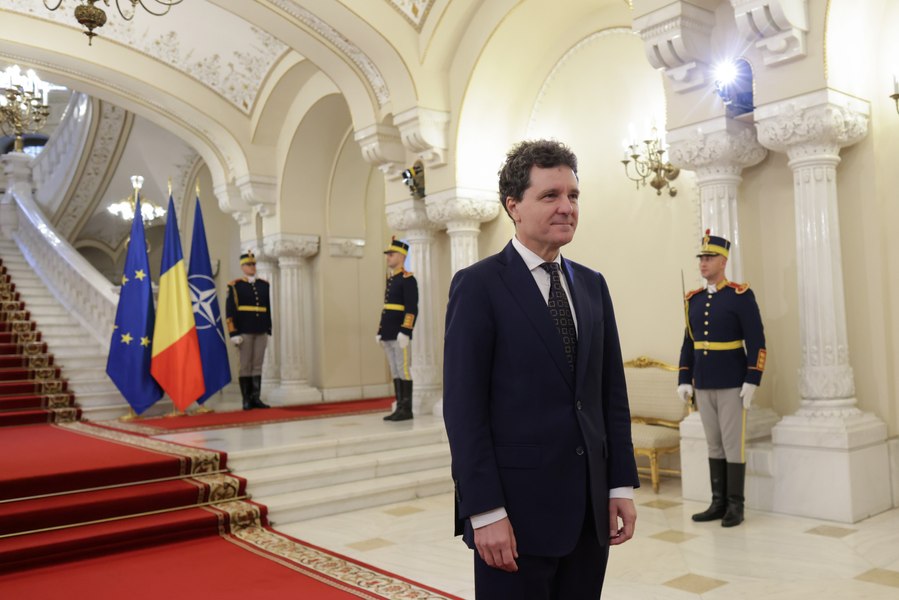

Everyone Against Everyone
Translated from Romanian and summarized by DistantNews. Read the original for the full story.
At a glance
News
Named sources
Context piece
- Official consultations in Romania between President Nicușor Dan and parliamentary parties failed to yield a majority for forming a new government.
- Parties are unwilling to compromise, with the PSD, responsible for the crisis, not explicitly seeking to govern, while AUR has.
- The president faces the decision of whom to entrust with the mandate, with speculation of a technocratic candidate, but challenges remain regarding political support and economic reforms.
The political deadlock in Romania persists as official consultations between President Nicușor Dan and parliamentary parties have concluded without a viable path to forming a new government. The expected outcome – no majority, no solution – has materialized, underscoring the deep divisions and lack of consensus among the political actors. The 7-hour meeting at Cotroceni Palace yielded little more than performative gestures, with parties engaging in image-saving tactics for their domestic audiences.
The primary instigator of the crisis, the Social Democratic Party (PSD), conspicuously avoided a direct bid for governance, leaving that to the Our Romania Union (AUR), another signatory of the no-confidence motion. The ensuing discussions revealed a complex web of inter-party animosity: PSD rejects Bolojan, PNL and USR reject PSD, PSD rejects AUR, AUR is self-absorbed, and the Democratic Alliance of Hungarians in Romania (UDMR) finds itself isolated without a viable partner. The Minorities group, however, is open to reviving the former coalition.
President Dan's central question – whether a majority exists – was met with a resounding no. The onus now falls on the President to decide whom to entrust with the mandate. Whispers of a technocratic nominee, a figure with a proven professional reputation, are circulating. However, the article questions the motivation for such an individual to abandon a stable career for a position fraught with uncertainty, lack of guaranteed respect, and the potential ill-faith of those who would vote them in. What could a technocrat truly achieve in office when facing entrenched political interests and the risk of becoming a scapegoat, as seen with the Dacian Cioloș government?
The economic implications of continued political instability are severe. Agencies are already issuing warnings: abandoning the deficit reduction program could lead to a downgrade of Romania's country rating, increased interest rates, and significant financing difficulties, ultimately degrading the standard of living. This mirrors Greece's cautionary tale of fiscal irresponsibility leading to bankruptcy and harsh reforms. The article suggests that some parties might even support a technocratic premier precisely to shift blame, a strategy that proved successful for PSD in 2016. However, the current political climate presents a different, more perilous scenario, where a technocratic government could become a political target, potentially backfiring on the parties that installed it.
About this summary
Originally published by Adevărul in Romanian. Translated, summarized, and contextualized automatically by DistantNews, with a note on how the source frames the story. Not individually reviewed before publishing. How this works.
More Stories
From Our Blog

News in Translation: What Gets Lost, and How We Keep the Framing

Diaspora Media: How Communities Abroad Follow Home

Traveling Where the Press Is Not Free: How to Read the News There

The Digital Nomad's Guide to Local News

The Same Story, Different Countries: How Coverage Changes at the Border
