

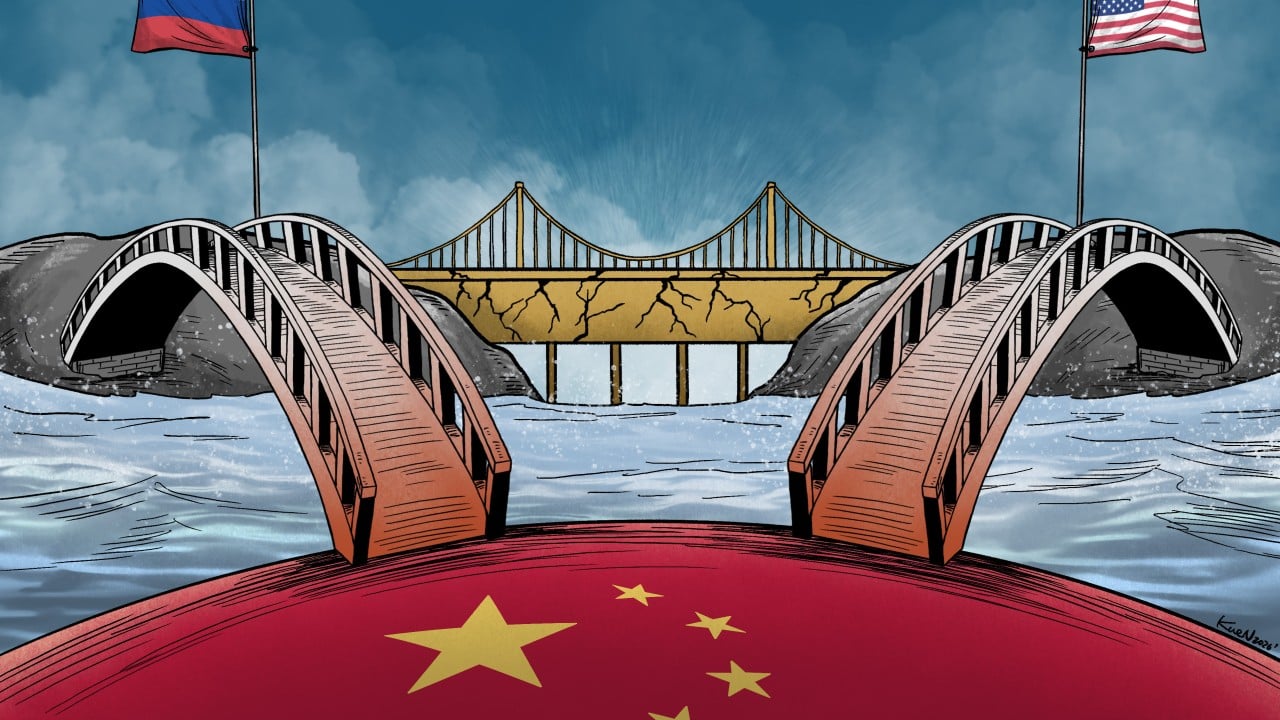
First Trump, then Putin go to China. Does great-power diplomacy now hinge on Beijing?
Summarized and contextualized by DistantNews.
At a glance
Analysis
Named sources
Context piece
- Recent summits involving leaders from the U.S., Russia, and China highlight Beijing's growing diplomatic influence and its ability to manage relationships with both Washington and Moscow separately.
- Analysts suggest this dynamic is reshaping global power structures, making them increasingly asymmetrical and unpredictable.
- While China appears central to global diplomacy, its ultimate standing remains a subject of debate among observers.
Recent high-profile summits, including those attended by leaders from the United States and Russia, underscore China's expanding role in global diplomacy, prompting observers to question whether Beijing now holds a pivotal position in great-power relations. The pattern suggests Beijing's increasing capacity to navigate its complex relationships by treating its strategic partnership with Moscow and its engagement with Washington on separate tracks.
Analysts note that this approach is reshaping the dynamics between the U.S., China, and Russia, leading to a more asymmetrical and unpredictable international landscape. This evolving situation will continue to test Beijing's ability to balance divergent interests amidst ongoing conflicts in Ukraine and the Middle East, volatile energy markets, and the rise of a multipolar nuclear order.
Major power leaders keep coming to China, and this naturally creates the impression that the United States and Russia, to some extent, need China.
Yun Sun, director of the China program at the Stimson Centre, observed that the frequent visits by major world leaders to China create a strong impression that both the United States and Russia, to some extent, rely on Beijing. "This makes China appear to sit at the centre of global power, a pivot of world diplomacy," Sun said. "This view has some merit... But whether this truly elevates China’s standing remains debatable."
The summits highlight China's strategic maneuvering, sustaining a deep partnership with Russia while pursuing a more transactional, stability-focused engagement with the U.S. This dual approach allows Beijing to exert influence while mitigating risks associated with its complex geopolitical position. The ongoing global challenges provide fertile ground for China to assert its diplomatic weight, positioning itself as a key mediator or influencer in various international arenas.
This makes China appear to sit at the centre of global power, a pivot of world diplomacy. This view has some merit … But whether this truly elevates China’s standing remains debatable.
DistantNews Editorial
Originally published by South China Morning Post. Summarized and contextualized by our editorial team with added local perspective. Read our editorial standards.
More Stories

From Our Blog

Countries Without a Free Press: What You Need to Know

What Press Freedom Means for the News You Read

What Gets Lost (and Found) When News Is Translated

The Critical Role of Diaspora Media in Global News

What Travellers Should Know About Countries with Restricted Press
