

Fossil discovery suggests mammal-like reptiles gave birth to live young, rewriting evolutionary history
Translated from Estonian, summarized and contextualized by DistantNews.
At a glance
News
Sources not specified
Context piece
- A new study of fossils suggests mammal-like reptiles, known as cynodonts, gave birth to live young.
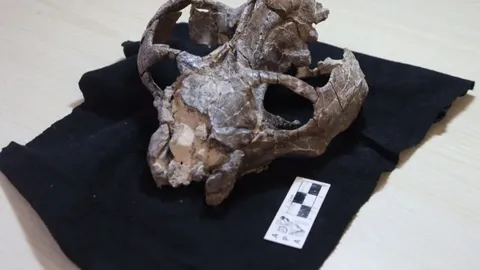
- Analysis of fossilized bone tissue from Chiniquodon theotonicus, which lived about 236 million years ago, shows a body mass ratio between offspring and adults similar to modern mammals.
- This finding could push back the evolutionary origin of live birth by up to 95 million years.
A groundbreaking study of fossilized remains is challenging long-held beliefs about mammalian evolution, suggesting that live birth may have originated much earlier than previously thought. The research focuses on cynodonts, reptile-like creatures that were ancestors to mammals.
Scientists analyzed the bone tissue of Chiniquodon theotonicus, an animal that lived approximately 236 million years ago. Their findings indicate a striking similarity in the ratio of offspring body mass to adult body mass compared to modern mammals. This suggests that these ancient creatures reproduced by giving birth to live young, rather than laying eggs.
If confirmed, this discovery could significantly alter the timeline of mammalian evolution, potentially pushing back the origin of live birth by as much as 95 million years. The study's implications extend to understanding the complex evolutionary path that led to the diverse mammalian species alive today.
DistantNews Editorial
Originally published by Postimees in Estonian. Translated, summarized, and contextualized by our editorial team with added local perspective. Read our editorial standards.
More Stories
/nginx/o/2026/08/14/17847680t1hb046.jpg)
/nginx/o/2026/08/13/17845677t1h4f1c.jpg)

From Our Blog

What Gets Lost (and Found) When News Is Translated

The Critical Role of Diaspora Media in Global News

What Travellers Should Know About Countries with Restricted Press

A Digital Nomad's Guide to Following Local News

How the Same Story Looks Different in Different Countries
