

From Lugoj to Mars: The Story of the Romanian at NASA Who Protected Astronauts from Deadly Radiation
Translated from Romanian, summarized and contextualized by DistantNews.
TLDR
- Ramona Gaza, a Romanian physicist, played a crucial role at NASA as the deputy director of the Radiation Systems, ensuring astronaut safety from cosmic radiation during the Artemis II mission.
- Gaza, who emigrated from Lugoj, Romania, to pursue her studies in physics in the US, earned her Ph.D. from Oklahoma State University and has dedicated two decades to protecting astronauts.
- Her work on radiation shielding, including the AstroRad vest, is vital for human space exploration and has potential applications for life on Earth.
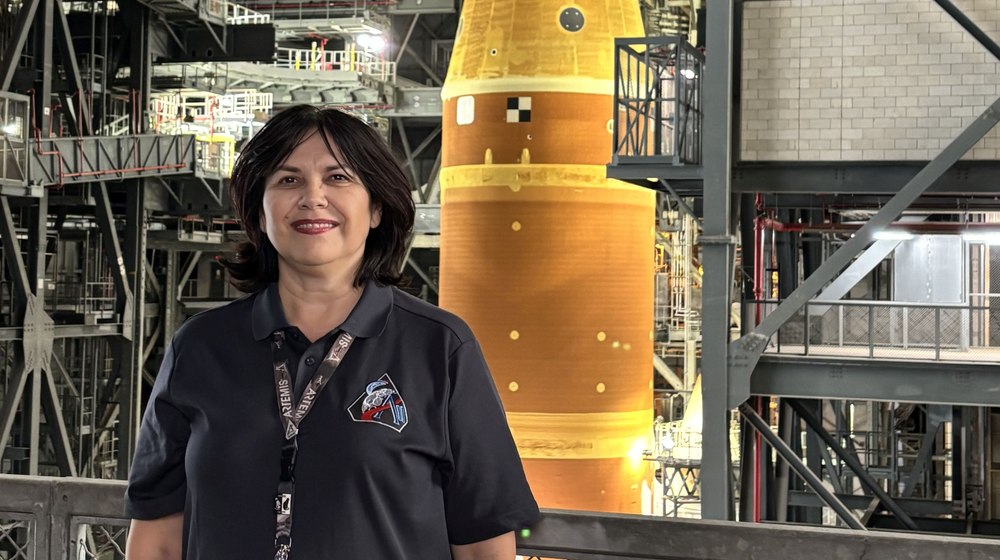
From the heart of Lugoj to the frontiers of space, Ramona Gaza's journey is a testament to Romanian ingenuity and dedication. As the deputy director of NASA's Radiation Systems, Gaza has been instrumental in safeguarding astronauts from the perils of deep space, a mission that culminated in her vital contributions to the success of the Artemis II mission. This mission, which saw humans orbit the far side of the Moon for the first time in 53 years, relied heavily on Gaza's expertise in mitigating the immense threat of cosmic radiation.
When I was very young, my dream was to become a teacher! However, in my adolescence, I developed a passion for Sci-Fi books and came to the conclusion that if there was a way to truly understand what I was reading, it would most likely involve studying physics. And that, of course, is because physics explains everything!
Gaza's path to NASA is one of remarkable academic and professional achievement. Born in Lugoj, Romania, she pursued her passion for physics at the West University of Timișoara before moving to the United States to complete her master's and doctoral studies at Oklahoma State University. Her doctoral research focused on space radiation dosimetry, laying the groundwork for her future work at NASA's Johnson Space Center, where she has spent two decades ensuring the safety of human spaceflight.
My research involved unique applications of solid-state detectors, particularly optically stimulated luminescence dosimeters and their potential use for measuring space radiation in low Earth orbit (LEO); the title of my doctoral thesis was 'Space Radiation Dosimetry: An Optically Stimulated Luminescence Radiation Detector for Low-Eatyh Orbit'.
Her role extends beyond mere scientific contribution; it embodies a profound commitment to the future of space exploration. The radiation protection systems she helps develop, such as the AstroRad vest, are not only critical for missions like Artemis but also hold the potential to save lives here on Earth. Gaza's story, bridging her Romanian roots with her pioneering work at NASA, is a source of national pride and an inspiration, showcasing how scientific pursuit can transcend borders and contribute to humanity's greatest endeavors.
After graduating, I was very grateful for the opportunity to implement my research operationally at NASA Johnson Space Center, where my work focuses on protecting astronauts from space radiation.
DistantNews Editorial
Originally published by Adevărul in Romanian. Translated, summarized, and contextualized by our editorial team with added local perspective. Read our editorial standards.
More Stories
From Our Blog

What Gets Lost (and Found) When News Is Translated

The Critical Role of Diaspora Media in Global News

What Travellers Should Know About Countries with Restricted Press

A Digital Nomad's Guide to Following Local News

How the Same Story Looks Different in Different Countries
