

From Rice Straw to Riches: Entrepreneurship Supports Local Communities
Translated from Vietnamese, summarized and contextualized by DistantNews.
At a glance
In-depth
Sources not specified
Context piece
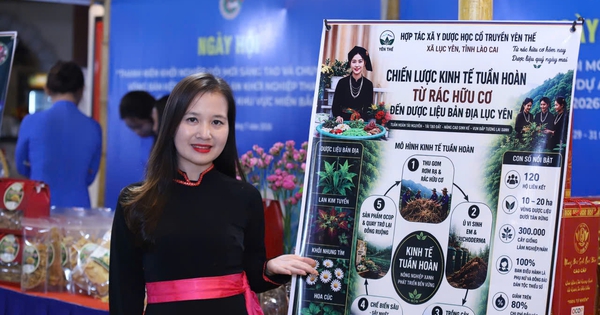
- Nông Thị Thắm, a former state employee, left her stable job to start a business using rice straw in Lục Yên commune, Lào Cai province, aiming to keep local communities connected to their homeland.
- She established the Yên Thế Traditional Medicine Cooperative, focusing on a circular agricultural ecosystem to boost economic value and protect the environment.
- Thắm transforms agricultural waste like rice straw and kitchen scraps into organic fertilizer using a simple biological fermentation process, reducing reliance on costly chemical fertilizers for local farmers.
In the mountainous commune of Lục Yên, Lào Cai province, Nông Thị Thắm is pioneering a sustainable agricultural model that not only revitalizes the local economy but also fosters a deeper connection between ethnic minority communities and their land. A former state employee with a background in agricultural science and tourism, Thắm chose to return to her roots, driven by a desire to apply her knowledge practically and address the persistent challenges faced by local farmers.
What can I do to apply my agricultural expertise to real life? Moreover, every time I see farmers in my hometown struggling with the cycle of good harvests and falling prices, and production costs becoming increasingly expensive, I yearn to do something more practical.
Witnessing farmers struggle with fluctuating prices and rising production costs, Thắm felt compelled to create a more impactful solution. In late 2024, she resigned from her position to establish the Yên Thế Traditional Medicine Cooperative. Her vision is to build a closed-loop, circular agricultural ecosystem that maximizes economic benefits while prioritizing environmental protection.
"We believe that entrepreneurship doesn't necessarily have to start with grand gestures. Sometimes it begins with a single blade of straw in the field, a medicinal herb on the hillside, fueled by love for one's homeland and the aspiration to contribute to the community," Thắm explained. Her venture began with the humble rice straw, a material often discarded or burned by farmers.
We believe that entrepreneurship doesn't necessarily have to start with grand gestures. Sometimes it begins with a single blade of straw in the field, a medicinal herb on the hillside, fueled by love for one's homeland and the aspiration to contribute to the community.
Thắm's innovative approach tackles the issue of agricultural waste head-on. Traditionally, farmers in her region would burn rice straw and other crop residues after harvest, leading to environmental pollution and soil degradation. Simultaneously, they incurred significant expenses on chemical fertilizers, often spending between 30 to 40 million Vietnamese dong per hectare annually. Thắm introduced a simple yet effective method: using biological agents to ferment rice straw, weeds, and kitchen waste into nutrient-rich organic fertilizer. This process, requiring no complex machinery, transforms waste into a valuable resource within 30 to 60 days, significantly reducing farmers' costs and improving soil health.
This process is very simple; the biological fermentation agents I guide farmers to use do not require complex machinery. Just 30 to 60 days of fermentation, and the rice straw will decompose into nutrient-rich organic fertilizer.
DistantNews Editorial
Originally published by Thanh Niên in Vietnamese. Translated, summarized, and contextualized by our editorial team with added local perspective. Read our editorial standards.
More Stories
From Our Blog

What Gets Lost (and Found) When News Is Translated

The Critical Role of Diaspora Media in Global News

What Travellers Should Know About Countries with Restricted Press

A Digital Nomad's Guide to Following Local News

How the Same Story Looks Different in Different Countries
