

Fuego volcano reduces eruptive activity in Guatemala; risk remains
Translated from Spanish, summarized and contextualized by DistantNews.
At a glance
News
Named sources
Context piece
- Guatemala's Fuego volcano has reduced its eruptive activity after a significant eruption.
- Experts warn that the risk of pyroclastic flows, or "hot avalanches," remains high.
- Over 1,700 people were evacuated, and authorities maintain a red alert in surrounding departments.
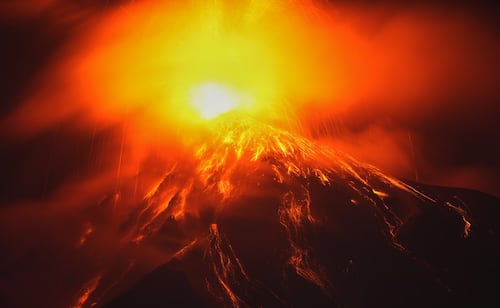
Guatemala's Fuego volcano, Central America's most active, has decreased its eruptive activity following a powerful eruption that prompted the evacuation of over 1,700 people. While the volcano appears calmer, experts and civil protection authorities caution that the threat of pyroclastic flows, described as "hot avalanches" of material, persists.
The volcano, located 35 km from the Guatemalan capital, began an eruptive phase early Monday, expelling lava and generating large columns of gas and ash throughout Tuesday night and Wednesday morning. The Institute of Vulcanology anticipates a gradual decrease in eruptive activity but stresses that a sudden descent of accumulated hot material is still possible.
These pyroclastic flows pose the "greatest threat to communities located near" the ravines, particularly on the volcano's southwest flank, according to the state agency. From the southern city of Escuintla, where displaced residents from villages on the volcano's slopes are sheltered, AFP journalists observed minor expulsions of gas and ash from the seemingly calm volcano.
Valeria Urízar, spokesperson for the National Coordinator for Disaster Reduction (Conred), informed journalists that some evacuated residents had begun returning to their homes voluntarily, despite ongoing warnings about the persistent risks. A red alert, signifying maximum danger, remains in effect for the departments of Escuintla, Sacatepéquez, and Chimaltenango, which surround the 3,763-meter-high volcano.
The Fuego volcano is one of three active volcanoes in Guatemala, alongside Pacaya and Santiaguito. A devastating eruption on June 3, 2018, caused an avalanche that wiped out a community, resulting in 215 deaths and a similar number of disappearances. More recent eruptive phases occurred in February and June 2025, leading to the evacuation of approximately 800 people. In 1932, an eruption was so significant that its ash reached El Salvador and Honduras.
Se espera que la actividad eruptiva disminuya gradualmente, pero no se descarta la posibilidad de un descenso abrupto de "corrientes" de material ardiente acumulado durante la potente erupción.
DistantNews Editorial
Originally published by El Universal in Spanish. Translated, summarized, and contextualized by our editorial team with added local perspective. Read our editorial standards.
More Stories

From Our Blog

What Press Freedom Means for the News You Read

What Gets Lost (and Found) When News Is Translated

The Critical Role of Diaspora Media in Global News

What Travellers Should Know About Countries with Restricted Press

A Digital Nomad's Guide to Following Local News
