


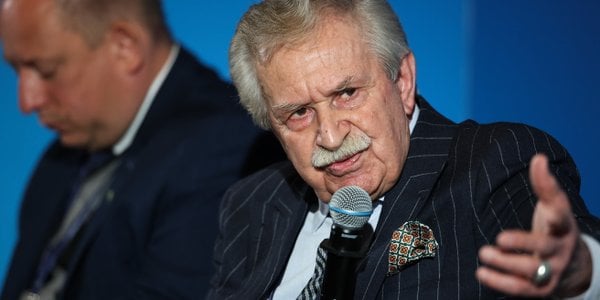
Gen. Leon Komornicki on Ukraine: He Speaks of 'Creeping Betrayal'
Translated from Polish, summarized and contextualized by DistantNews.
At a glance
Opinion
Named sources
Context piece
- Former Polish Deputy Chief of Staff Gen. Leon Komornicki criticizes Ukraine's naming of a unit after the UPA, calling it a "creeping betrayal."
- Komornicki argues that Ukraine's historical narrative, particularly its embrace of Bandera's ideology, is a betrayal of Polish-Ukrainian historical ties and present-day cooperation.
- He also expresses concern about potential "hidden agents" among Ukrainian refugees in Poland and describes Poland as a "cardboard country" lacking foresight.
General Leon Komornicki, former deputy chief of staff of the Polish Army, has sharply criticized Ukraine's decision to name a military unit after the Ukrainian Insurgent Army (UPA). He described the move as a "betrayal" and an insult, evoking a visceral reaction akin to being spat upon.
I felt as if someone had spat in my face. Someone will say that 'I feel that way' or that 'these are emotions.' These are not emotions, calm is maintained here. But the measure by which we should measure this behavior is exactly this.
Komornicki contends that Ukraine's historical narrative, particularly its foundation on the ideology of Stepan Bandera, represents a "creeping betrayal" that began in 1993. He highlighted shared historical experiences, including participation in Soviet enslavement, where Ukrainians held significant positions within the Soviet military, which he views as a betrayal of Poland.
This is the same thing repeating itself in a different time and space, although it is not the same behavior as when Nazi Germany entered. We show heart and dedication, and they strike at us. They betrayed us then too. And what is this today if not betrayal? Except that this betrayal has had a creeping character since 1993.
Expressing skepticism about the influx of Ukrainian refugees into Poland, Komornicki warned of potential "hidden agents" among them. He characterized Poland as a "cardboard country" that operates on emotions and short-term interests, lacking the long-term strategic vision of a serious nation.
Often, these people who fled here are people from eastern Ukraine. Those from the west went to fight, and they fled from the east. We need to realize who is among us. These are also people from eastern Ukraine, there can be a lot of so-called hidden agents here. We are not even aware of this. Because we are like children in the fog, we are not like a serious country, we are often a cardboard country.
Furthermore, Komornicki asserted that Ukraine's strategic goals are simple: to create misunderstandings with Poland by building on the "Banderite ideology." He questioned whether Bandera's legacy aligns with European values, especially in light of perceived discrimination against Poles, which he believes is ignored due to political convenience. He referenced the recent controversy surrounding the awarding and subsequent rescinding of Polish state honors to Ukrainian officials, viewing it as a humiliation of Poland.
And they are the same as Russians. They are not Europeans. They want to be part of the EU, but on their own terms. Is Banderism a European value? Or discriminating against Poles? This is not talked about because it is inconvenient.
DistantNews Editorial
Originally published by Rzeczpospolita in Polish. Translated, summarized, and contextualized by our editorial team with added local perspective. Read our editorial standards.
More Stories

From Our Blog

What Gets Lost (and Found) When News Is Translated

The Critical Role of Diaspora Media in Global News

What Travellers Should Know About Countries with Restricted Press

A Digital Nomad's Guide to Following Local News

How the Same Story Looks Different in Different Countries
