


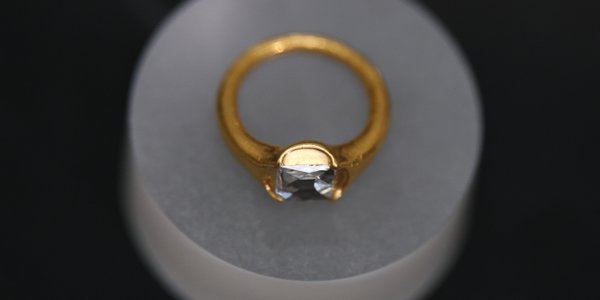
Germany returns WWII-looted royal ring to Poland
Translated from Polish, summarized and contextualized by DistantNews.
At a glance
News
Named sources
Outcome reported
- A gold ring belonging to King Sigismund I the Old, stolen by German troops during WWII, has been returned to Poland.
- The ring, part of the "Royal Casket," is now on display at the Czartoryski Museum in Krakow.
- Its return is part of broader efforts to restore cultural heritage and improve Polish-German relations.
A significant piece of Polish royal history has returned home after decades. A gold ring adorned with a diamond, once belonging to King Sigismund I the Old and looted by German forces during World War II, has been recovered and is now back in the collection of the Czartoryski Museum in Krakow.
When we recover lost cultural assets, we do not just recover objects. We recover fragments of our history that were taken from Poland. We recover testaments to the memory, the work of collectors, the care of museum staff, and the continuity of Polish culture.
The signet ring, originating from the "Royal Casket," is available for public viewing as of Thursday. The official handover ceremony took place at the museum's courtyard. Minister of Culture and National Heritage Marta Cienkowska described the moment as one where "history returns home." She emphasized that recovering lost cultural assets means reclaiming not just objects, but fragments of Polish history, testaments to collectors' work, and the continuity of Polish culture.
Today's return is part of a larger change. In recent months, we have truly seen a new opening in Polish-German relations in the area of returning cultural assets.
This restitution aligns with celebrations marking the 35th anniversary of the Polish-German treaty on good neighborliness and friendly cooperation. Alongside the ring, a fragment of a medieval manuscript containing the anthem "Gaude Mater Polonia" and 11 miniature railway exhibits from a pre-war Warsaw museum were also returned by Germany in mid-June. Minister Cienkowska noted this return signifies a "new opening" in Polish-German relations concerning cultural property, with further restitution efforts planned.
one of the most spectacular symbolic wartime losses.
Museum director Prof. Andrzej Szczerski called the ring "one of the most spectacular symbolic wartime losses." He highlighted its significance as part of the "Royal Casket," a collection tied to royal traditions, especially poignant given the irreversible destruction of Polish regalia by Prussian troops after the Third Partition. Dr. Katarzyna Płonka-Bałus, a curator at the museum, described the ring as a "triple witness" to the death of a monarch, the splendor of the Jagiellonian Golden Age, and national dramas, emphasizing the need to reconnect broken threads of cultural memory.
The ring will be an important element of the narrative as a triple witness: to the majesty of death of one of Europe's greatest monarchs, the splendor of the Jagiellonian Golden Age, and finally, national dramas and historical continuity. (...) It reminds not only of the importance of cultural memory, but above all, that its broken threads can and must be constantly reconnected.
DistantNews Editorial
Originally published by Rzeczpospolita in Polish. Translated, summarized, and contextualized by our editorial team with added local perspective. Read our editorial standards.
More Stories


From Our Blog

What Gets Lost (and Found) When News Is Translated

The Critical Role of Diaspora Media in Global News

What Travellers Should Know About Countries with Restricted Press

A Digital Nomad's Guide to Following Local News

How the Same Story Looks Different in Different Countries
