


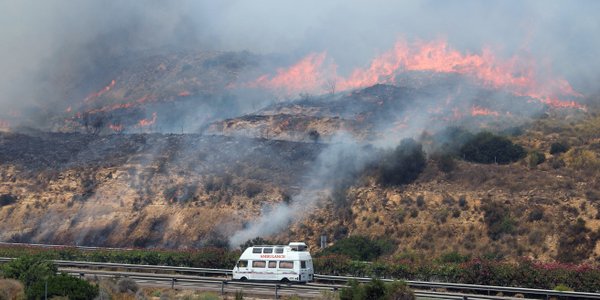
Goats and sheep: Europe finds a way to fight fires with the 'shepherding method'
Translated from Polish, summarized and contextualized by DistantNews.
At a glance
News
Named sources
Context piece
- Goats and sheep are being used in Europe to prevent wildfires by grazing on flammable vegetation, creating natural firebreaks.
- This "shepherding method" has shown success in several Spanish regions, with the EU and agricultural lobbies supporting its wider use.
- Farmers seek financial support for this practice, as it is currently not profitable enough to attract young people, while experts criticize the EU for focusing on firefighting rather than landscape management.
A "shepherding method" employing herds of goats and sheep is emerging as a novel strategy to combat Europe's escalating wildfire crisis. These animals effectively clear dry grasses, shrubs, and young branches, thereby establishing natural firebreaks that impede the rapid spread of flames. This approach has already demonstrated its efficacy in various Spanish regions, garnering support from both agricultural lobbies and the European Commission for broader implementation.
The method involves strategically grazing livestock, particularly goats, to consume vegetation that fuels fires. This creates a buffer zone, hindering fire progression. Experts note that many European wildfires originate in overgrown, unused lands bordering forests. The Copernicus satellite observation program has confirmed that fires often ignite in areas where forests and scrubland converge, highlighting the need for proactive landscape management.
That attest is important. That proves, for example, that your home is sufficiently insulated and energetically sound.
However, farmers argue that the current market offers little incentive for shepherds. Jose Maria Castilla of the Spanish agricultural lobby ASAJA points out that the profession struggles to attract young people due to its lack of profitability. He advocates for a dedicated European fund to support this practice. In a Catalan initiative called Ramats de Foc, shepherds are co-financed by EU agricultural funds and local authorities to graze animals in high-risk forest areas identified by the fire department.
I have noted in recent months that there are sometimes very high fines when not everything is in order on time. We are talking about monster fines of more than 20,000 euros.
Farmers involved in these projects sell products like cheese and yogurt with labels indicating that proceeds contribute to wildfire prevention efforts. In some Spanish regions, goats, sheep, cows, and even horses are utilized for grazing on designated lands. Experts have previously criticized the EU for prioritizing firefighting and emergency response over systemic solutions for landscape management. The advisory council of the European Academies of Sciences recommended strategic grazing as a key tool to reduce the size and intensity of wildfires.
Local authorities in Madrid, a region heavily impacted by fires, are also considering this preventative measure. Plans announced earlier this year involve local farms grazing animals across 3,700 hectares of forested land, with an estimated cost for the initiative.
We must not punish people for an administrative error. That is why we opt for better communication, extra time, and lower fines. This way, we help people instead of fining them.
DistantNews Editorial
Originally published by Rzeczpospolita in Polish. Translated, summarized, and contextualized by our editorial team with added local perspective. Read our editorial standards.
More Stories

From Our Blog

What Gets Lost (and Found) When News Is Translated

The Critical Role of Diaspora Media in Global News

What Travellers Should Know About Countries with Restricted Press

A Digital Nomad's Guide to Following Local News

How the Same Story Looks Different in Different Countries
