


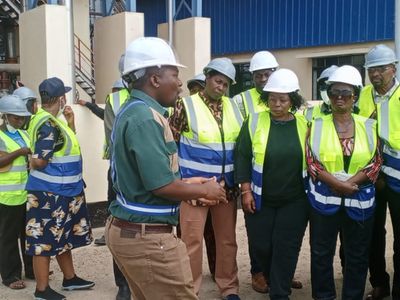

Government officially moves to Mtumba after spending 698 billion shillings
Translated from Swahili and summarized by DistantNews. Read the original for the full story.
At a glance
News
Named sources
New plan
- Tanzania will officially move government operations to its Mtumba complex, where 18,510 employees are expected to work.
- President Samia Suluhu Hassan will inaugurate the buildings and 57.1 kilometers of completed paved roads on September 8, 2026.
- Construction has so far cost 698 billion shillings out of a planned 940 billion, with parts of the project still under construction.
Tanzania is set to formally move its government operations to Mtumba, where 18,510 employees will work in newly built offices and government facilities.
President Samia Suluhu Hassan will inaugurate the complex on September 8, 2026, at the Mashujaa grounds in Mtumba. She will also open 57.1 kilometers of paved roads that have already been completed.
Palamagamba Kabudi, the minister in the Prime Minister’s Office responsible for policy, Parliament, coordination and people with disabilities, said the project has so far cost 698 billion shillings. The approved spending plan totals 940 billion shillings, although construction work remains under way.
The first phase of construction of 23 temporary office buildings began on November 28, 2018, and was completed on March 22, 2019.
The inauguration will cover offices for 26 ministries and 11 government institutions. Employees from all of them have already begun working in the new buildings. The first phase, which included 23 temporary office buildings, began on November 28, 2018, and ended on March 22, 2019. It allowed some staff from the Office of the Attorney General and the Rural and Urban Roads Agency, known as Tarura, to move to Mtumba.
The second phase began in October 2021 and focused on permanent offices, roads and social infrastructure. Remaining work includes 42 kilometers of underground electricity infrastructure, water and sewage systems, information technology facilities, closed-circuit security cameras, a fire station, and landscaping. Kabudi said the design follows a smart-city concept, including green features, renewable energy, rainwater harvesting and environmental-impact planning. The buildings use four prototypes designed for institutions employing about 150, 300, 500 or 1,400 people. Kabudi said it was still too early to comment on the complex’s name, which had previously been called Magufuli City.
The work at different stages of implementation includes underground electricity infrastructure extending 42 kilometers; clean-water and sewage systems in the government city; information technology; the installation of security systems, including CCTV cameras; a fire station; and implementation of the plan to plant and develop the government city.
About this summary
Originally published by Mwananchi in Swahili. Translated, summarized, and contextualized automatically by DistantNews, with a note on how the source frames the story. Not individually reviewed before publishing. How this works.
More Stories


From Our Blog

News in Translation: What Gets Lost, and How We Keep the Framing

Diaspora Media: How Communities Follow News From Home

Traveling Where the Press Is Not Free: How to Read the News There

The Digital Nomad's Guide to Local News

The Same Story, Different Countries: How Coverage Changes at the Border
