


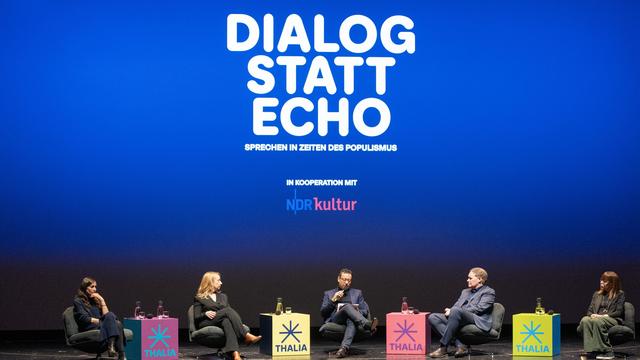
Hamburg discussion tackles dialogue in the age of populism
Translated from German, summarized and contextualized by DistantNews.
TLDR
- A discussion at the Thalia Theater explored "speaking in times of populism" and improving dialogue amid differing opinions.
- Participants criticized a ZEIT commentary on left-wing parties as "intellectually substandard" and discussed how social media algorithms amplify provocative content.
- The conversation highlighted the challenge of engaging in constructive debate when individuals are primarily exposed to content that triggers them, often for commercial reasons by tech companies.
In Hamburg, a recent discussion at the Thalia Theater, titled "Dialogue Instead of Echo," delved into the complexities of "speaking in times of populism." While the event was ostensibly sparked by Milo Rau's "Trial Against Germany," the conversation quickly broadened to encompass fundamental questions about politics, the state, the media, and how we can foster better communication when disagreements arise.
The participants, armed with impressive eloquence and quick wit, grappled with these significant themes. However, the discussion left some attendees with a sense of frustration, as it raised many stimulating ideas but failed to definitively resolve any core questions. A particularly resonant moment occurred when several speakers voiced strong criticism of a past ZEIT commentary titled "Are the Leftists to Blame Themselves?" which was deemed "intellectually substandard" by Culture Senator Carsten Brosda.
This was "intellectually substandard".
Further complicating the discourse, journalist Melanie Amann shared an anecdote about a farmer friend who was deeply angered by a Spiegel commentary on the farmer protests. This friend, however, had not recognized the broader spectrum of diverse and nuanced reporting on the same topic within Spiegel. Amann posited that this illustrates a critical problem: individuals relying solely on social media often encounter content designed to provoke them, a phenomenon amplified by tech companies like Google and Meta for commercial gain, as it increases user engagement. This observation, while plausible, seemed to echo the very performative contradiction demonstrated earlier in the discussion regarding the ZEIT commentary.
Wer sich nur in sozialen Medien informiere, bekomme vor allem Texte zu sehen, die ihn provozieren (oder neudeutsch: die ihn triggern).
DistantNews Editorial
Originally published by Die Zeit in German. Translated, summarized, and contextualized by our editorial team with added local perspective. Read our editorial standards.
More Stories



From Our Blog

What Gets Lost (and Found) When News Is Translated

How the Same Story Looks Different in Different Countries

The Critical Role of Diaspora Media in Global News

What Travellers Should Know About Countries with Restricted Press

A Digital Nomad's Guide to Following Local News
