


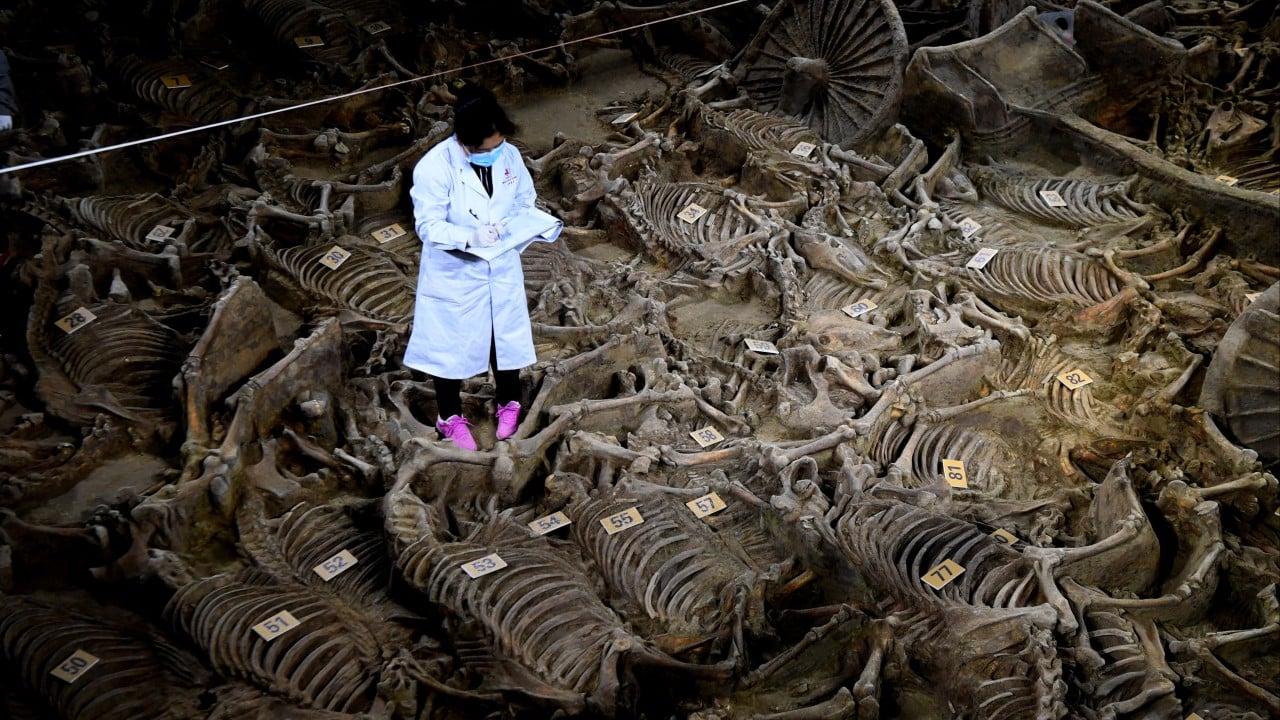
Hegemony or balance of power? What the wars of ancient China teach us
Summarized and contextualized by DistantNews.
At a glance
Analysis
Named sources
Context piece
- The article explores the concept of hegemony versus a balance of power, drawing parallels with ancient Chinese warfare.
- It references historian A.J.P. Taylor's views on the nature of power among European states.
- The text questions the effectiveness of a balance of power system, noting its tendency to lead to periodic wars.
The enduring tension between hegemony and a balance of power, a concept explored through the lens of ancient Chinese wars, is examined in this article. It begins by referencing historian A.J.P. Taylor's stark depiction of European Great Powers operating in a perpetual state of "nature," where violence was the only law, and life was "nasty, brutish, and short."
In the state of nature which Hobbes imagined, violence was the only law, and life was ‘nasty brutish and short’,” he wrote in The Struggle for Mastery in Europe, 1848-1918. “Though individuals never lived in this state of nature, the Great Powers of Europe have always done so. Sovereign states have distinguished European civilisation, at any rate since the end of the fifteenth century. Each individual state in Europe acknowledged no superior and recognised no moral code other than that voluntarily accepted by its own conscience …
Taylor argued that while individual states may not have lived in such a state, the collective of sovereign European states, since the 15th century, has consistently operated without a superior authority. This condition, he suggested, should theoretically lead to constant warfare. However, Europe has experienced periods of peace, which Taylor attributed to the "Balance of Power."
If Hobbes saw true, he wrote, “the history of Europe should be one of uninterrupted war. In fact, Europe has known almost as much peace as war; and it has owed these periods of peace to the Balance of Power”.
Despite its role in maintaining peace, the balance of power system is presented as inherently unstable and exhausting for statesmen. The constant vigilance and strategic maneuvering required resemble anarchy, leading to periodic outbreaks of conflict. The article concludes by posing the question of alternatives, referencing Hobbes' idea that the simplest "solution" to anarchy is for one power to subdue all others.
Men have not always acquiesced in the perpetual quadrille of the Balance of Power,” he continued. “They have often wished that the music would stop and that they could sit out a dance without maintaining the ceaseless watch on each other.”
DistantNews Editorial
Originally published by South China Morning Post. Summarized and contextualized by our editorial team with added local perspective. Read our editorial standards.
More Stories


From Our Blog

Countries Without a Free Press: What You Need to Know

What Press Freedom Means for the News You Read

What Gets Lost (and Found) When News Is Translated

The Critical Role of Diaspora Media in Global News

What Travellers Should Know About Countries with Restricted Press
